Concrete driveways cost more upfront. Asphalt driveways cost more over time. That single sentence captures the core of this debate — but the right answer for your home depends on your climate, budget, and how much maintenance you want to handle.
Both are proven materials. Both work. The difference is in the trade-offs: asphalt installs cheaper and faster, flexes better in cold climates, and repairs easily. Concrete lasts twice as long, handles heat far better, requires minimal maintenance, and offers decorative options that asphalt simply cannot match.
This guide compares both materials on every factor that matters — 2026 cost data, lifespan, climate performance, maintenance demands, repair difficulty, environmental impact, and resale value — so you can make the right call for your specific situation.
Concrete vs Asphalt Driveway: Head-to-Head Comparison
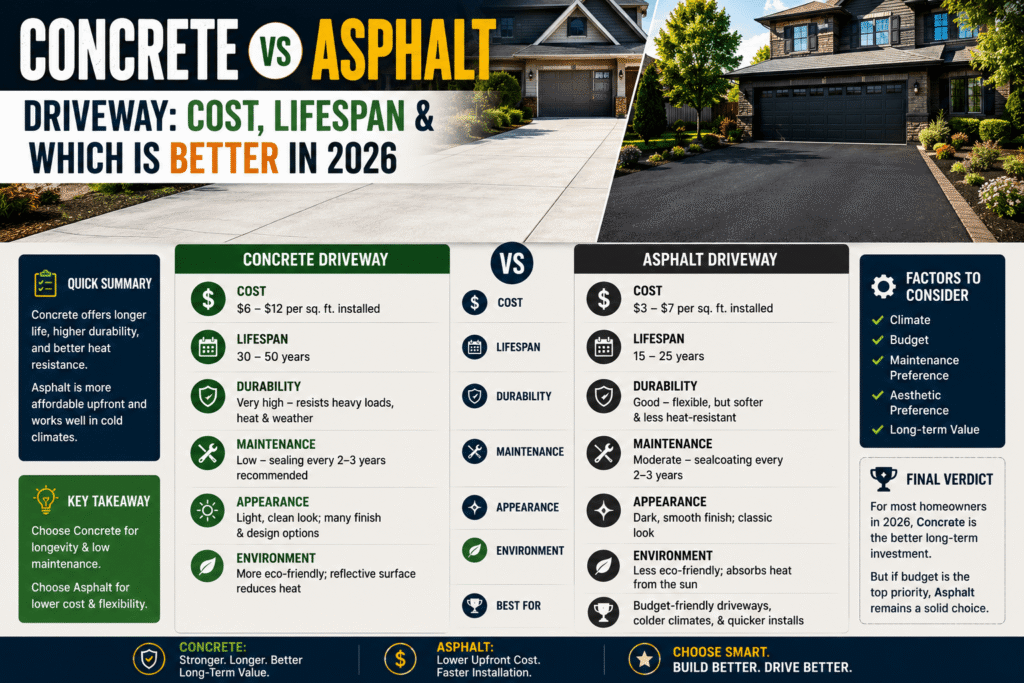
Here is the full side-by-side comparison across every factor homeowners care about:
| Factor | Concrete Driveway | Asphalt Driveway |
| Install Cost (2026) | $6–$15 per sq ft | $4–$9 per sq ft |
| Avg. Project (600 sq ft) | $3,600–$9,000 | $2,400–$5,400 |
| Lifespan | 30–50 years | 15–25 years |
| Sealing Required | Every 5–10 yrs (optional) | Every 2–3 yrs (mandatory) |
| Repair Cost | $300–$3,000 (difficult) | $100–$800 (easy) |
| Hot Climate Performance | Excellent — stays firm | Poor — softens, ruts |
| Cold/Freeze-Thaw | Good with air-entrained mix | Very good — flexes |
| Snow/Ice Removal | Avoid salt — causes spalling | Salt-tolerant surface |
| Customization | High — stamp, color, expose agg. | Low — flat black only |
| Resale Value Impact | +$5,000–$10,000 perceived value | Moderate — clean = positive |
| Environmental | Longer life; CO2 from cement | 99% recyclable; petroleum-based |
| Time to Use | 7–10 days (cure time) | 24–48 hours |
| 30-Year Total Cost* | $7,000–$10,000 | $9,000–$13,000 |
*30-year total cost estimates include installation + maintenance (resealing, repairs) for a standard 600 sq ft driveway.
What Each Material Actually Is
What Is a Concrete Driveway?
A concrete driveway is a rigid slab made of Portland cement, sand, gravel, and water, typically reinforced with steel rebar or welded wire mesh. Concrete achieves compressive strengths of 4,000–6,000 PSI depending on mix design. It cures into a hard, inflexible surface that resists deformation, heat, and surface wear for decades with minimal attention.
Standard residential concrete driveways are poured 4 inches (100 mm) thick for normal passenger vehicles, and 6 inches (150 mm) for heavy trucks, RVs, or boats. Control joints cut or tooled into the surface at regular intervals direct natural cracking to planned lines rather than random fractures.
What Is an Asphalt Driveway?
An asphalt driveway is a flexible surface made of crushed stone, sand, and bitumen — a petroleum-derived binding agent. It installs as a hot mixture (160–177°C / 320–350°F) that is compacted by rolling equipment and hardens as it cools. Asphalt is viscoelastic — it flexes slightly under load and with temperature change, which is both its main advantage and its main limitation.
Standard residential asphalt driveways are 2–3 inches (50–75 mm) thick over a 6–8 inch compacted gravel base. The surface is uniformly black when new and fades to gray as it oxidizes with UV exposure. Sealcoating every 2–3 years slows this oxidation and restores the appearance.
Cost Comparison: Installation, Maintenance & 30-Year Total
The upfront price difference is real — but it is not the complete picture. Asphalt’s lower install cost comes with a higher long-term maintenance bill.
| Project | Concrete Cost | Asphalt Cost | Difference |
| 400 sq ft (small) | $2,400–$6,000 | $1,600–$3,600 | Asphalt saves $800–$2,400 |
| 600 sq ft (standard) | $3,600–$9,000 | $2,400–$5,400 | Asphalt saves $1,200–$3,600 |
| 800 sq ft (large) | $4,800–$12,000 | $3,200–$7,200 | Asphalt saves $1,600–$4,800 |
| Resurfacing (600 sq ft) | $850–$2,900 | $200–$2,200 | Asphalt saves $650–$700 |
| Crack repair | $300–$3,000 | $100–$800 | Asphalt saves $200–$2,200 |
Why Concrete Costs More Upfront
Concrete requires more materials by volume (higher cement content), longer installation time (forming, finishing, curing management), and more skilled labor for decorative options. The curing period adds days to the project timeline before the driveway can be used. These factors combine to push the price 30–50% above asphalt for a basic comparable installation.
Why Asphalt Costs More Over 30 Years
Sealcoating every 2–3 years costs $200–$500 per application. Over 30 years, that is 10–15 applications — $2,000–$7,500 in maintenance cost alone. Add 1–2 asphalt resurfacings ($1,000–$3,000 each) and a likely full replacement within 20–25 years, and the lifetime cost of asphalt typically exceeds concrete by $2,000–$4,000 for a standard driveway.
The 30-Year Math
A 600 sq ft concrete driveway installed for $6,000 with $1,500 in total maintenance over 30 years costs $7,500 over its life. The same asphalt driveway installed for $3,600, resurfaced once ($1,500), maintained consistently ($4,500 in sealcoating over 25 years), and replaced once at year 20 ($3,600) runs $13,200. Concrete is the better long-term value for homeowners who stay in their home.
Lifespan and Durability
Concrete: 30–50 Years
A properly installed concrete driveway lasts 30–50 years with minimal intervention. The keys are: correct mix design (4,000 PSI minimum, air-entrained in freeze-thaw climates), adequate thickness, proper subgrade compaction, correctly spaced control joints, and no deicing salt use. When those conditions are met, concrete is essentially a set-and-forget surface for decades.
Concrete’s weakness is cracking from ground movement, frost heave, or tree root pressure. Because it is rigid, it cannot flex — it fractures. Repairs to cracked concrete are expensive ($300–$3,000 per panel) and color matching is rarely perfect, making repairs visually obvious.
Asphalt: 15–25 Years
An asphalt driveway maintained with regular sealcoating lasts 20–25 years. Without sealcoating, expect significant deterioration within 10 years. Asphalt oxidizes from UV exposure, losing flexibility and developing surface cracking (called alligator cracking) that allows water infiltration, accelerating damage. In hot climates, asphalt softens above surface temperatures of roughly 49°C (120°F) — parked cars can leave tire impressions in mid-summer in Arizona or Texas.
Asphalt’s strength is repairability. Cracks fill easily with liquid sealant. Potholes patch with cold-mix asphalt. Surface deterioration responds to resurfacing — a fresh 37–50 mm (1.5–2 inch) overlay that costs $1–$3/sq ft and restores the surface without full replacement.
Climate Performance: Which Material Wins by Region
Climate is the single most important factor in this decision. The wrong material for your climate will underperform regardless of price or maintenance.
| Climate / Region | Best Choice | Reason |
| Hot & humid (South, Southwest) | Concrete | Asphalt softens above 120°F, ruts under parked cars |
| Cold winters / freeze-thaw (Midwest, Northeast) | Asphalt (or air-entrained concrete) | Asphalt flexes with frost heave; concrete cracks if poorly installed |
| Moderate / temperate (most of USA) | Either — concrete preferred for longevity | Both perform well; concrete wins on maintenance & appearance |
| Coastal / salt-air | Concrete (with sealer) | Salt is concrete’s enemy only when deicing; coastal air alone is fine |
| High UV / desert | Concrete | Asphalt oxidizes and degrades faster under intense UV exposure |
Cold Climates: Asphalt’s Advantage
Asphalt’s flexibility is a structural advantage in freeze-thaw climates. When frozen ground heaves upward, asphalt rises with it and settles back when the ground thaws. Concrete, being rigid, cracks under the same stress. Asphalt also absorbs heat from sunlight more effectively, which passively melts snow on sunny winter days — reducing deicing salt needs.
However: asphalt is not immune to freeze-thaw damage. Water infiltration through unsealed or cracked asphalt freezes in the sub-surface, expanding and causing potholes. The maintenance requirement of sealcoating every 2–3 years is directly linked to this vulnerability — skip it and the surface degrades rapidly in northern climates.
Hot Climates: Concrete’s Clear Win
In hot climates, concrete is definitively the better material. Asphalt’s bitumen binder softens at high temperatures, causing the surface to deform under the weight of parked vehicles — a problem called rutting. On a 38°C (100°F) summer day, asphalt surface temperatures can exceed 65°C (150°F), well past its softening threshold. This is not a theoretical concern: homeowners in Phoenix, Houston, and Las Vegas commonly report tire impressions and surface deformation with asphalt.
Concrete’s lighter color also reflects more solar radiation, keeping the surface cooler — a meaningful comfort advantage for pool surrounds, play areas, and barefoot traffic.
Maintenance Requirements
Asphalt Maintenance: 4 Ongoing Tasks
- Sealcoating every 2–3 years: Mandatory, not optional. Apply first sealcoat 6–12 months after installation. After that, reseal every 2–3 years to prevent UV oxidation, water infiltration, and surface cracking. DIY sealcoating runs $50–$150 for materials; professional application costs $200–$500.
- Crack filling as needed: Fill cracks wider than 3 mm (1/8 inch) before they allow water infiltration. Liquid crack filler costs $10–$20 per tube at hardware stores. Do this before every sealcoating cycle.
- No petroleum-based solvents: Oil, gasoline, and hydraulic fluid dissolve asphalt’s bitumen binder. Clean spills immediately. Long-term parking of leaking vehicles causes permanent surface damage.
- Salt-tolerant but not ideal: Rock salt and deicing chemicals do not damage asphalt the way they damage concrete. However, the water penetration caused by freeze-thaw still requires attention through consistent sealcoating.
Concrete Maintenance: 3 Simpler Tasks
- Sealing every 5–10 years: Optional in moderate climates, recommended in freeze-thaw regions. Sealing reduces moisture penetration and protects against deicing salt damage. Penetrating sealers ($30–$60/gallon) are most common. Far less frequent than asphalt’s 2–3 year cycle.
- No salt or deicing chemicals: This is concrete’s most important maintenance rule. Sodium chloride (rock salt) accelerates a destructive process called spalling — surface scaling and pitting that starts within 1–2 seasons of repeated salt use. Use sand for traction or calcium magnesium acetate (CMA) instead.
- Prompt stain removal: Concrete is porous and stains from oil, grease, and organic material more visibly than asphalt. Clean spills within 24 hours with a degreaser. Oil stains left for weeks become permanent. Sealed concrete resists staining significantly better than unsealed.
Appearance and Customization
Concrete wins this category completely. Asphalt offers one appearance option: flat black, fading to gray over time. Concrete opens the door to a full range of decorative finishes that can add thousands of dollars to perceived property value:
- Stamped concrete: Pattern mats pressed into fresh concrete create the look of brick, slate, cobblestone, flagstone, or wood plank. Costs $12–$25/sq ft installed.
- Integral color: Pigment mixed into the concrete before pour — runs through the full slab depth. Available in dozens of earth tones, grays, and warm colors.
- Exposed aggregate: Surface paste washed away while fresh to reveal the decorative stone aggregate below. Creates a natural, textured, slip-resistant surface.
- Broom finish: The standard residential finish — parallel texture lines brushed across the surface while fresh. Provides traction and a clean, neutral appearance.
- Polished / acid-stained: Interior-grade decorative finishes that produce marble-like coloration and sheen on concrete floors.
Asphalt can be enhanced with decorative borders (using brick or paver edging), colored sealers (limited palette), or exposed aggregate sections — but these are supplementary, not intrinsic to the material.
Repair: Asphalt Is Easier, Concrete Is More Permanent
Asphalt Repairs
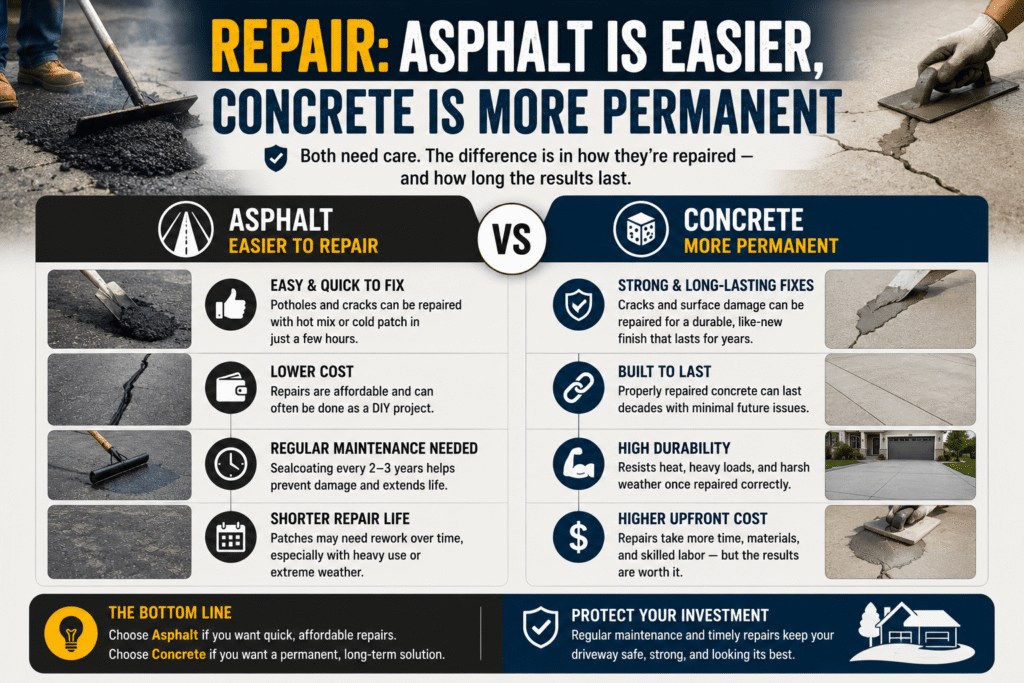
Asphalt repairs are easy, affordable, and blend in reasonably well. Small cracks: liquid crack filler, $10–$20. Medium cracks and potholes: cold-mix patch, $15–$30 per bag. Widespread surface deterioration: hot-mix resurfacing overlay at $1–$3/sq ft. The dark color of asphalt helps new repairs blend with the existing surface far better than concrete patches.
Asphalt can be resurfaced — a 37–50 mm (1.5–2 inch) fresh overlay poured over the existing surface resets the clock without full removal. This option does not exist for concrete.
Concrete Repairs
Concrete repairs are more complex and rarely invisible. Small hairline cracks: polyurethane crack filler, $15–$40. Larger structural cracks and spalled sections: require cutting out the affected panel and pouring a replacement section — $300–$3,000 depending on size. The new concrete section will be lighter in color than the weathered surrounding slab, making repairs visually obvious even when done correctly.
This is one of the most important practical limitations of concrete that competitors routinely understate: if your driveway cracks significantly in year 8 from a tree root or ground settling, fixing it properly is expensive and will still show.
Environmental Impact
Asphalt
Asphalt is the most recycled material in the United States — approximately 99% of removed asphalt pavement is recycled into new asphalt. Old driveways are milled, reprocessed, and relaid as new surfaces with minimal waste. Asphalt is a petroleum-based product, which raises concerns about fossil fuel extraction and the potential for bitumen compounds to leach into groundwater over time. Standard asphalt is also impermeable, creating stormwater runoff.
Permeable asphalt (porous asphalt) is available and allows water to drain through the surface into a gravel sub-base — a meaningful environmental upgrade that reduces runoff and recharges groundwater.
Concrete
Portland cement production is responsible for approximately 8% of global CO2 emissions — a significant environmental cost concentrated in the manufacturing phase. However, concrete’s 30–50 year lifespan means far fewer replacements than asphalt over the same time period, which partially offsets the manufacturing footprint.
Concrete’s lighter color reduces the urban heat island effect — it reflects rather than absorbs solar radiation, lowering ambient temperatures in urban and suburban settings. Newer concrete formulations incorporate fly ash, slag, and recycled aggregate to reduce cement content and carbon footprint without sacrificing performance.
Resale Value Impact
Both materials add value when well-maintained. The difference is in magnitude:
- Concrete driveway: Adds $5,000–$10,000 in perceived value according to real estate professionals. Stamped or decorative concrete stands out as a premium feature during showings. In neighborhoods with mostly concrete driveways, an asphalt driveway can actually reduce relative appeal.
- Asphalt driveway: A freshly sealed asphalt driveway looks clean, dark, and well-maintained — a positive signal to buyers. ROI is typically 50–70% of installation cost. In markets where asphalt is the regional norm (northern states, rural areas), it carries no negative connotation.
- Neglected driveway of either material: Cracked, faded, or potholed driveways signal deferred maintenance and reduce buyer confidence. Condition matters more than material.
The strongest resale play is either a freshly sealed asphalt surface (low cost to restore appearance) or a stamped/colored concrete driveway (premium visual feature that buyers remember).
Which Should You Choose? Decision Framework
The answer depends on 4 factors:
Choose Concrete If:
- You live in a hot climate (South, Southwest, Sun Belt) where asphalt softens
- You plan to stay in the home 15+ years and want to minimize lifetime maintenance
- Curb appeal and resale value are priorities — especially for higher-end neighborhoods
- You want decorative options: stamped patterns, integral color, exposed aggregate
- You have heavy vehicles (trucks, RVs, boats) that would rut asphalt in heat
- You want to install it and largely forget about it for decades
Choose Asphalt If:
- You live in a cold climate with severe freeze-thaw cycles (Midwest, Northeast, Canada)
- Your budget is tight and the 30–40% lower install cost is the deciding factor
- You want to use the driveway within 24–48 hours of installation
- You are comfortable with the 2–3 year sealcoating maintenance cycle
- You plan to sell within 5–10 years and want the best short-term ROI
- You have a very long driveway where the per-square-foot savings is substantial
Bottom Line
For warm and temperate climates: concrete. For cold climates on a budget: asphalt with consistent maintenance. If you plan to stay in your home long-term and want the lowest total cost of ownership, concrete wins in most regions. If you need the lowest upfront cost and live where winters are harsh, asphalt is the practical choice.
Why Your Driveway Choice Affects Your Roof
Driveway and roofing materials are linked through water management. A properly graded concrete or asphalt driveway directs stormwater away from the foundation and home — reducing the hydrostatic pressure and soil saturation that contribute to roof deck damage, fascia rot, and water infiltration. Poorly graded driveways that slope toward the structure are a leading cause of the moisture problems our roof repair professionals diagnose during inspections.
For homes with flat or low-slope roofing sections over garages and carports, the structural connection between the driveway slab and the roof system is direct. Concrete slab quality under a carport determines how the roofing membrane is anchored and sealed at the transition point. Failures at these transitions are among the most common repairs our commercial roof repair team handles on attached garage structures.
Homes with concrete tile roofing benefit from matching the driveway material — a concrete driveway under a concrete tile roof creates a unified aesthetic that consistently tests as a premium combination in buyer surveys. A professional roof inspection of your full property, including the garage and carport roofing, is a smart companion step when replacing or installing a new driveway.
New driveway construction also creates an opportunity to address gutter and drainage improvements at the same time. Proper downspout extensions that deposit water well beyond the driveway edge prevent the pooling that accelerates edge deterioration in both concrete and asphalt. Our roof maintenance services include drainage assessment as part of every annual inspection.
Conclusion
Both concrete and asphalt driveways are proven, durable materials. Neither is universally better — the right choice depends on your climate, budget, and time horizon.
Choose concrete for: hot climates, long-term value, low maintenance, and curb appeal. Choose asphalt for: cold climates, lower upfront cost, fast installation, and easy repairs.
If you plan to stay in your home 15+ years in a moderate or warm climate, concrete’s lower lifetime cost and better appearance will pay back the higher installation price. If you need the most driveway for the least money now especially in a northern state asphalt with consistent maintenance is the practical answer.