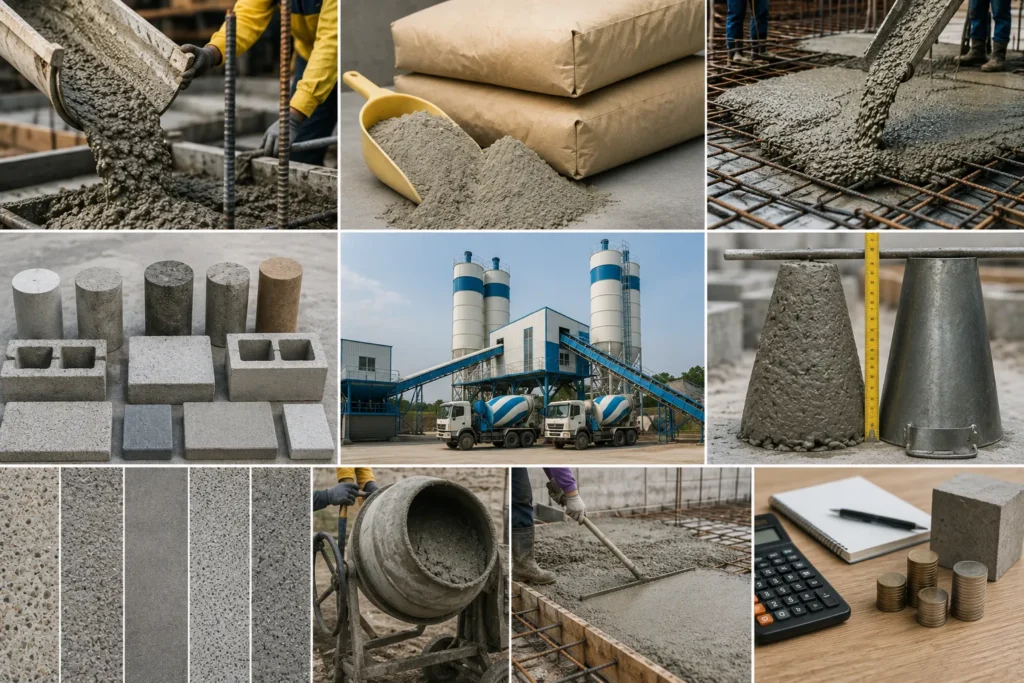
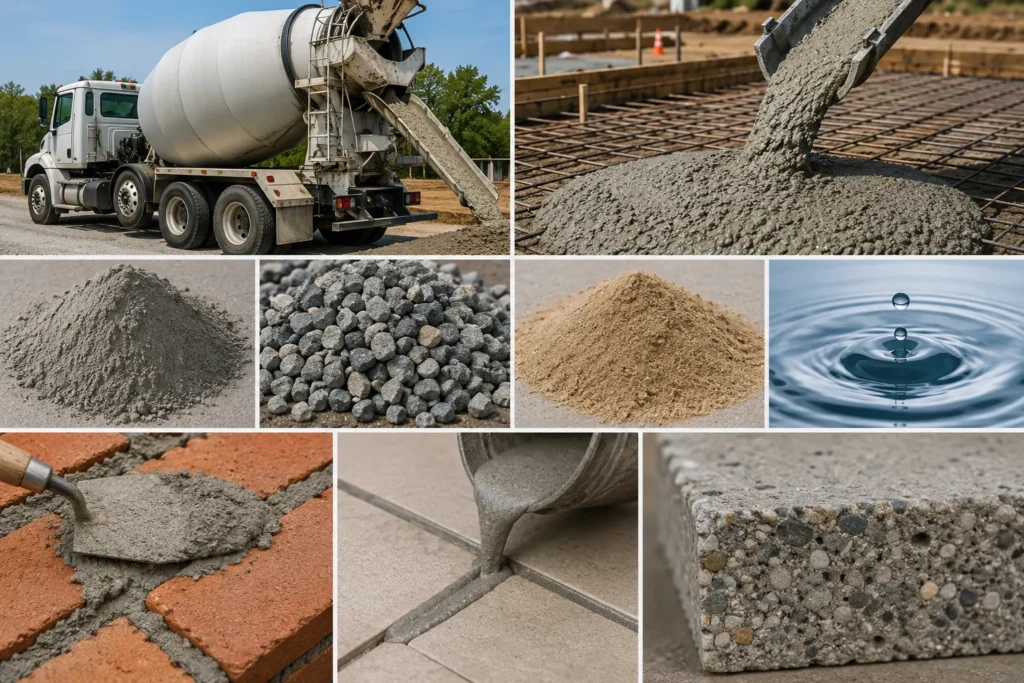
Portland cement concrete (PCC) is a building material made from Portland cement, water, and aggregates such as sand, gravel, and crushed stone. The cement reacts with water, hardens through a chemical process called hydration, and locks the aggregates into a solid mass. American contractors pour PCC for driveways, sidewalks, foundations, highways, and bridges.
The name causes confusion. Portland is not a brand and has nothing to do with Portland, Oregon. Joseph Aspdin, an English bricklayer, patented the material in 1824 and named it after limestone from the Isle of Portland in England because the hardened product looked similar.
This guide covers the 5 ASTM cement types, exact mix ratios, curing times, 2026 prices, and the industry shift to Type IL cement. Every number comes from current U.S. standards and market data.
Cement vs Concrete: What Is the Difference?
Cement is an ingredient. Concrete is the finished product. Portland cement makes up only 10% to 15% of a typical concrete mix by volume. The rest is 60% to 75% aggregates, 15% to 20% water, and 5% to 8% air.
People say “cement truck” or “cement sidewalk” in daily conversation. Both terms are technically wrong. The truck carries concrete, and the sidewalk is concrete. Cement is the gray powder inside the mix that acts as the glue.
Mortar and grout differ from both. Mortar combines cement, sand, and water for bonding bricks and blocks. Grout uses a thinner, more fluid mix for filling joints and gaps. Concrete stands apart because it contains coarse aggregates, including gravel and crushed stone, which give the material its structural strength.
What Is Portland Cement Made Of?
Portland cement is made from limestone, clay, shale, and iron ore heated to 2,700°F (1,480°C) in a rotary kiln. The heat transforms these raw materials into marble-sized nodules called clinker. Manufacturers grind the clinker with 3% to 5% gypsum into the fine gray powder sold in bags.
Four chemical compounds control how the cement performs:
- Tricalcium silicate (C3S) drives early strength in the first 7 days
- Dicalcium silicate (C2S) builds long-term strength after 7 days
- Tricalcium aluminate (C3A) speeds up the initial set
- Tetracalcium aluminoferrite (C4AF) lowers the kiln temperature during production
When water touches the powder, these compounds form calcium silicate hydrate (C-S-H). This paste coats every particle of sand and gravel, then hardens into stone over 28 days.
5 Types of Portland Cement (ASTM C150)
ASTM International defines 5 portland cement types under standard C150, and each type serves a different exposure condition. The table below shows where each one belongs on a U.S. job site.
| Type | Best Use | Key Property |
| Type I | Driveways, sidewalks, buildings | General purpose |
| Type II | Foundations, drainage structures | Moderate sulfate resistance |
| Type III | Cold-weather pours, precast panels | High early strength |
| Type IV | Dams, mass pours | Low heat of hydration |
| Type V | Southwest soils, wastewater plants | High sulfate resistance |
Type I handles 90% of residential work. Type II protects concrete in soil with moderate sulfate levels, which is common across the Midwest. Type III reaches in 7 days the strength Type I reaches in 28 days, so contractors choose Type III when a slab must carry loads fast. Type V resists the high-sulfate soils found in Arizona, Nevada, and parts of California.
Check your local soil report before you pick a type. A soil test costs $15 to $40 (roughly £12 to £32) and prevents sulfate attack that can crack a foundation within 10 years.
Type IL Portland-Limestone Cement: The 2026 Standard
Type IL portland-limestone cement (PLC) has replaced ordinary portland cement (OPC) as the default cement across most of the United States. All 50 state Departments of Transportation now accept PLC, and major producers converted their plants between 2022 and 2025.
PLC blends 5% to 15% ground limestone into the cement under standard ASTM C595. The change cuts carbon emissions by about 10% per ton without lowering strength. A bag labeled Type IL performs the same as Type I in driveways, slabs, and sidewalks.
Why does this matter for your project in 2026? The bag at your local supplier probably says Type IL, not Type I. Mix ratios, water amounts, and curing steps stay identical. Finishers report that PLC feels slightly creamier under the trowel, and set times run close enough that no schedule change is needed.
Portland Cement Concrete Mix Ratio
The standard portland cement concrete mix ratio is 1 part cement, 2 parts sand, and 3 parts gravel by volume. This 1:2:3 mix produces concrete with a compressive strength near 3,000 psi (20.7 MPa), which handles patios, walkways, and slabs.
| Project | Ratio (Cement:Sand:Gravel) | Target Strength |
| Footings, fence posts | 1:3:5 | 2,500 psi (17.2 MPa) |
| Patios, sidewalks | 1:2:3 | 3,000 psi (20.7 MPa) |
| Driveways, garage slabs | 1:2:2.5 | 4,000 psi (27.6 MPa) |
| Structural columns | 1:1.5:3 | 4,500 psi (31 MPa) |
One 94 lb (42.6 kg) bag of portland cement mixed at 1:2:3 yields about 0.17 cubic yards (0.13 cubic meters) of concrete. A 10 ft × 10 ft patio at 4 inches thick needs 1.23 cubic yards, which means roughly 8 bags of cement plus matching sand and gravel.
Measure with a bucket, not a shovel. Shovel loads vary by 30% between scoops, and inconsistent ratios create weak spots that crack first.
Water-Cement Ratio and Strength
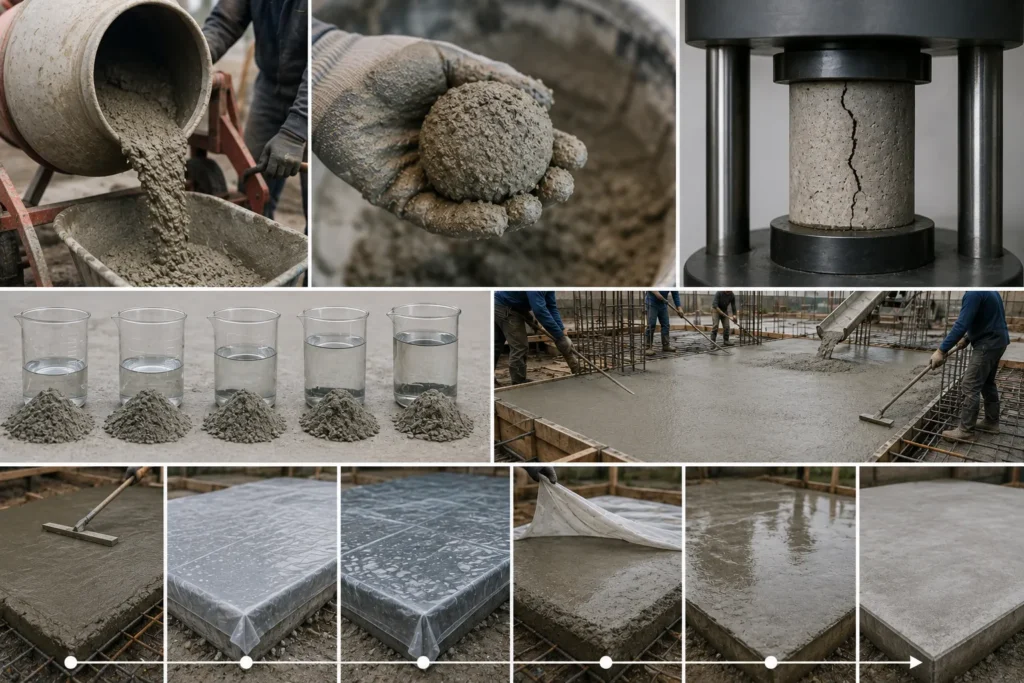
A water-cement (w/c) ratio between 0.45 and 0.55 gives the best balance of strength and workability for most projects. The ratio means pounds of water divided by pounds of cement. A 94 lb bag of cement needs 42 to 52 lb of water, which equals 5 to 6.2 gallons (19 to 23.5 liters).
Extra water is the most common strength killer. Raising the w/c ratio from 0.50 to 0.70 cuts compressive strength by nearly 40%. The surplus water evaporates, leaves microscopic pores behind, and turns dense concrete into a weak sponge.
The mix is right when it holds a ball shape in a gloved hand without dripping. Add a water-reducing admixture instead of more water if the mix feels too stiff to place.
Curing Timeline: 24 Hours to 28 Days
Portland cement concrete reaches full design strength in 28 days, but each milestone before that allows specific activities.
| Time | Strength Gained | What You Can Do |
| 24 hours | 15% | Walk carefully on the surface |
| 3 days | 40% | Allow foot traffic, remove forms |
| 7 days | 65% | Drive light vehicles on slabs |
| 14 days | 90% | Park regular cars and trucks |
| 28 days | 100% | Apply full structural loads |
Keep the surface wet for the first 7 days. Spray water twice daily, cover the slab with plastic sheeting, or apply a curing compound at $0.10 to $0.15 per square foot. Concrete that dries out on day 2 loses up to 50% of its potential strength, and no repair brings that strength back.
Cold weather changes the rules. Concrete must stay above 40°F (4.4°C) for the first 48 hours, so winter pours in northern states need insulated blankets or heated enclosures.
Portland Cement Concrete Cost in 2026
Ready-mix portland cement concrete costs $150 to $185 per cubic yard delivered in most U.S. markets in 2026. Prices climbed about 4% from 2025 due to energy and freight costs.
Bagged cement runs cheaper for small jobs:
- 94 lb (42.6 kg) portland cement bag: $14 to $19
- 80 lb (36.3 kg) pre-mixed concrete bag: $6 to $8
- 60 lb (27.2 kg) pre-mixed concrete bag: $5 to $7
A finished concrete driveway costs $6 to $12 per square foot installed, which covers material, labor, forms, and finishing. A standard 640 sq ft (59.5 m²) two-car driveway lands between $3,800 and $7,700 depending on region and thickness.
Order ready-mix for any project above 1 cubic yard. Mixing 47 bags by hand to match one truck delivery costs more in bags and takes 10+ hours of labor.
PCC vs Asphalt: Which Pavement Lasts Longer?
Portland cement concrete pavement lasts 30 to 50 years, while asphalt lasts 15 to 25 years. The Federal Highway Administration (FHWA) tracks both materials across the Interstate system, and PCC wins on lifespan in every climate zone.
Asphalt wins on upfront price at $3 to $7 per square foot against $6 to $12 for concrete. The math flips over 40 years because asphalt needs resealing every 3 to 5 years and full resurfacing around year 15. Concrete needs joint sealing every 10 years and little else.
Climate decides close calls. Concrete handles Arizona heat that softens asphalt, and asphalt flexes better under the freeze-thaw cycles that crack poorly drained concrete in Minnesota. Air-entrained PCC closes that gap by holding microscopic air bubbles that give freezing water room to expand.
5 Mistakes That Ruin a Concrete Pour
These 5 mistakes cause most residential concrete failures: excess water, skipped curing, wrong cement type, missing control joints, and cold-weather pours without protection.
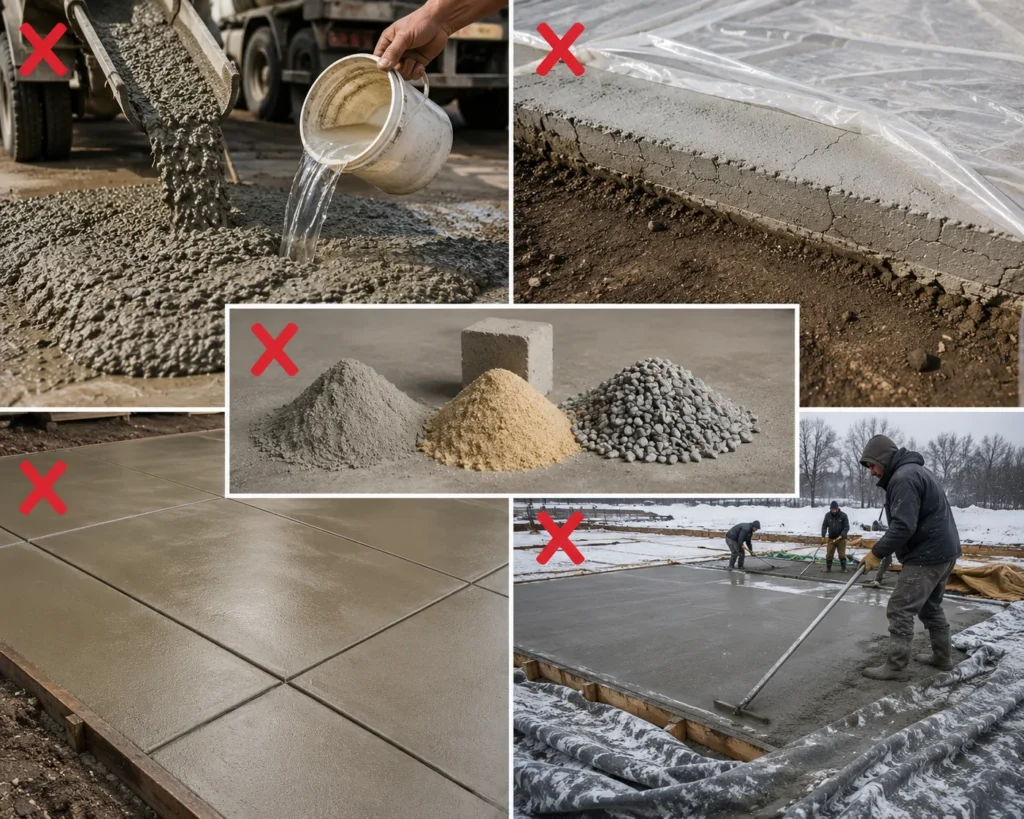
- Adding extra water for easier pouring. Each added gallon per bag cuts strength by up to 8% and increases surface dusting.
- Skipping the 7-day wet cure. Dry concrete stops gaining strength, and the loss is permanent.
- Using Type I cement in sulfate soil. Sulfates attack the hardened paste and crumble foundations within a decade. Use Type II or Type V after a soil test.
- Forgetting control joints. Cut joints at spacing equal to 24 times the slab thickness in inches. A 4-inch slab needs joints every 8 feet (2.4 meters).
- Pouring below 40°F (4.4°C) without blankets. Frozen mix water stops hydration and leaves a weak, flaky surface layer.
The Bottom Line
Portland cement concrete succeeds or fails on 3 decisions: the right cement type for your soil, a 1:2:3 mix with a 0.45 to 0.55 water-cement ratio, and a full 7-day wet cure. Get those 3 right, and a residential slab lasts 30+ years with almost no maintenance.
The 2026 market makes one thing simpler. Type IL portland-limestone cement now fills the shelf where Type I used to sit, and it performs the same in every driveway, patio, and foundation. Buy it, mix it at the ratios in this guide, and keep the water low.
Budget $150 to $185 per cubic yard for ready-mix, or $14 to $19 per 94 lb (42.6 kg) bag for small pours. Spend the extra $15 to $40 on a soil test before any foundation work in the Midwest or Southwest. That one test protects a $5,000 slab from sulfate damage that shows up too late to fix.