
Mortar and concrete come from the same ingredients but do completely different jobs. Using one where the other belongs causes failures that show up months or years later a crumbling joint, a cracked slab, a wall that moves when it should not.
Mortar bonds brick, block, and stone together. Concrete builds load-bearing slabs, foundations, and structural elements. The ingredient that separates them is coarse aggregate concrete has it, mortar does not. That single difference creates 7 performance gaps that determine which material belongs on your project.
This guide covers both materials in full: ingredients, compressive strength, types, mix ratios, cost, and 6 common project decisions where choosing the wrong material causes real damage.
What Is Concrete?
Concrete is a structural building material made from 4 ingredients: portland cement, sand, coarse aggregate (gravel or crushed stone), and water. The cement and water form a paste that coats every particle of sand and stone. As the paste hydrates and cures, it locks the aggregate into a rigid, load-bearing mass.
Residential concrete reaches 2,500–5,000 PSI compressive strength depending on mix design and application. Commercial and structural concrete targets 4,000–8,000 PSI. The coarse aggregate — typically 3/8-inch to 3/4-inch (9.5–19 mm) crushed stone or gravel — carries compressive loads through mechanical interlocking inside the cured mass.
Fresh concrete stays workable for 60–90 minutes after water contacts the mix. Full strength develops at 28 days. Concrete placed into forms and left to cure holds its shape permanently — it does not flex, compress, or release under sustained loads the way mortar does.
What Is Mortar?
Mortar is a masonry adhesive made from portland cement, masonry sand, water, and lime. Mortar contains no coarse aggregate — the absence of stone is deliberate. Fine-grained mortar spreads smoothly between masonry units, fills narrow joints of 3/8 inch to 1/2 inch (9.5–12.7 mm), and bonds brick, concrete block, and natural stone into stable wall assemblies.
Mortar compressive strength ranges from 350 PSI to 2,500 PSI — intentionally lower than the masonry units it bonds. A mortar joint must flex slightly with seasonal temperature movement and freeze-thaw cycling. If mortar were stronger than the brick, brick faces would spall instead of the joint releasing. The joint is the designed failure point — repointing a joint costs a fraction of replacing a cracked brick.
Lime content gives mortar workability, slow set time, and slight flexibility after cure. Masonry cement is a pre-blended version that includes the lime. Lime-only mortars (no portland cement) are used on historic restoration where original soft brick cannot tolerate the hardness of modern cement mortar.
Mortar vs Concrete: 7 Key Differences
| Feature | Concrete | Mortar |
| Ingredients | Cement, sand, water, coarse aggregate | Cement, sand, water, lime |
| Compressive Strength | 2,500–8,000 PSI | 350–2,500 PSI |
| Aggregate Size | 3/8–3/4 in (9.5–19 mm) stone | Fine masonry sand only |
| Consistency | Pourable — placed into forms | Paste-like — spread with trowel |
| Primary Function | Structural load-bearing | Masonry bonding adhesive |
| Flexibility | Rigid — zero flex after cure | Slight flex — sacrificial joint |
| Typical Lifespan | 50–200+ years | 25–50 years before repointing |
| Water-to-Cement Ratio | 0.40–0.55 (lower = stronger) | 0.50–0.70 (higher for workability) |
| Can Be Substituted | No — never use mortar for structural pours | No — never use concrete in masonry joints |
The substitution row matters most. Concrete in a masonry joint does not bond — it shrinks on cure and falls out. Mortar poured as a slab has no structural strength and cracks under any load. These are not interchangeable materials.
Types of Mortar: ASTM C270 Classification
ASTM C270 defines 4 standard mortar types based on compressive strength, bond strength, and flexibility. Choosing the wrong type for the application causes joint failure, water infiltration, or masonry unit damage.
| Mortar Type | Compressive Strength | Best Applications | Key Property |
| Type M | 2,500 PSI | Below-grade walls, foundations, retaining walls, driveways | Strongest — least flexible, limited bond |
| Type S | 1,800 PSI | At-grade masonry, exterior walls, patios, chimneys | High bond strength — best for most exterior work |
| Type N | 750 PSI | Above-grade exterior walls, brick veneer, stone veneer | Medium strength — most flexible, best for general use |
| Type O | 350 PSI | Interior non-load-bearing walls, historic restoration, soft brick | Lowest strength — highest flexibility, gentlest on old masonry |
Type N is the most widely used mortar on residential projects — correct for above-grade brick, block, and stone in most climates. Type S replaces Type N in freeze-thaw climates, high-wind zones, and below-grade applications. Type M is for structural masonry in ground contact. Type O is for non-structural interior joints and historic buildings only.
Mortar Mix Ratios by Type
| Mortar Type | Cement : Lime : Sand Ratio | Description |
| Type M | 1 : 1/4 : 3 | 1 part cement, 1/4 part lime, 3 parts sand |
| Type S | 1 : 1/2 : 4.5 | 1 part cement, 1/2 part lime, 4.5 parts sand |
| Type N | 1 : 1 : 6 | 1 part cement, 1 part lime, 6 parts sand |
| Type O | 1 : 2 : 9 | 1 part cement, 2 parts lime, 9 parts sand |
Higher lime content produces weaker, more flexible mortar. Higher cement content produces stronger, harder mortar. Never add extra cement to increase strength — harder mortar than the masonry unit spalls brick faces in freeze-thaw climates.
Types of Concrete: Mix Designs for Residential Projects
| Concrete Strength | Applications | Notes |
| 2,500 PSI | Sidewalks, residential patios, non-structural flatwork | Standard residential mix |
| 3,000 PSI | Driveways, garage slabs, standard footings | Most common residential pour |
| 3,500 PSI | Structural slabs, basement floors, pool decks | Moderate reinforcement typically added |
| 4,000 PSI | Commercial floors, heavy-load slabs, structural walls | Rebar or wire mesh required |
| 5,000 PSI+ | High-strength structural elements, bridges, industrial floors | Engineered mix design, admixtures added |
Residential driveways require minimum 3,000 PSI. Garage slabs with heavy vehicle loads need 3,500–4,000 PSI. Footings supporting structural loads require the engineer-specified mix — never substitute lower PSI to save cost on structural pours.
Concrete and mortar both appear in roofing applications — concrete tile roofs use mortar bedding to set ridge caps and hip tiles, while parapet walls and chimney flashings use Type S mortar for all joints. Proper roof installation specifies the correct mortar type for each junction — wrong mortar on a concrete tile roof causes joint failure within 5–10 years in freeze-thaw climates.
When to Use Concrete: 6 Residential Applications
Use concrete anywhere the project requires compressive strength, ground contact durability, or permanent load-bearing performance.
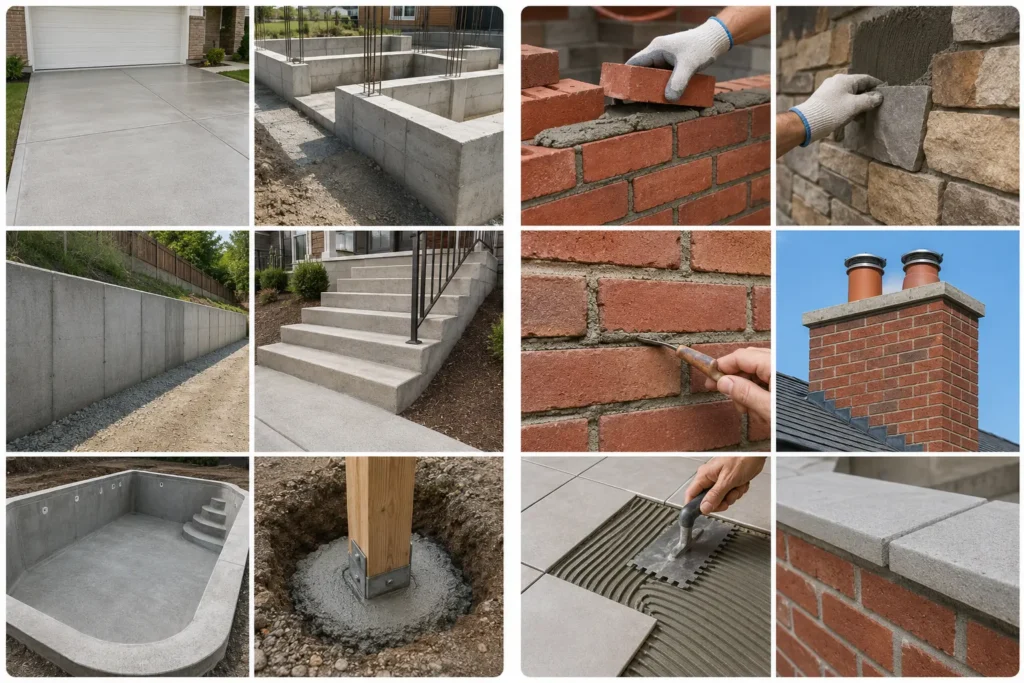
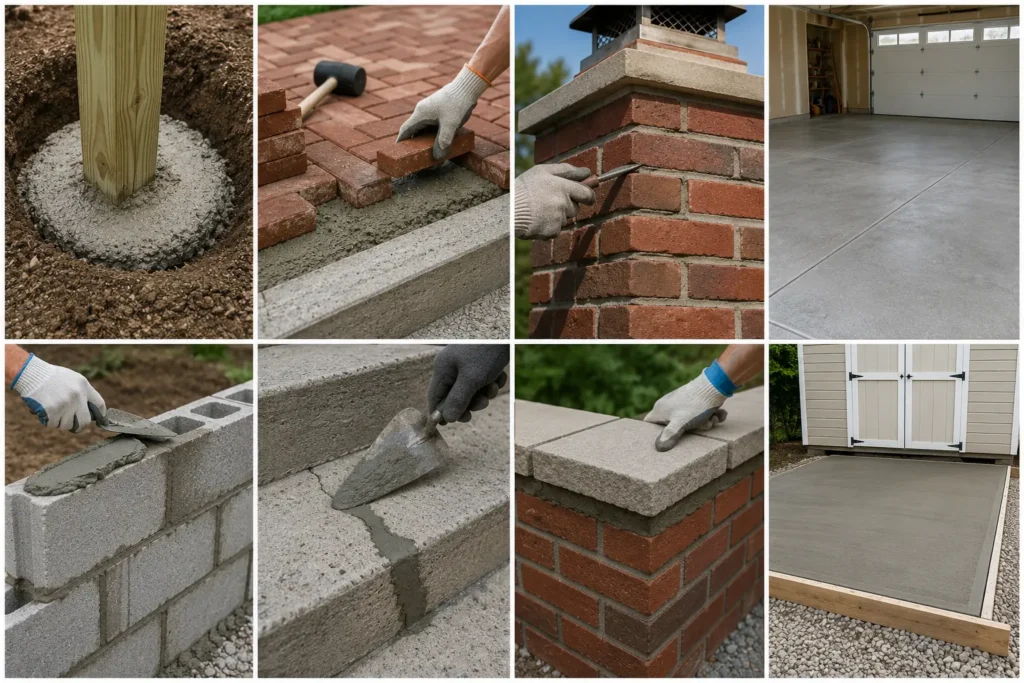
- Slabs and flatwork — garage floors, driveways, sidewalks, patios, and shed pads. Minimum 3,000 PSI with 4 inches (100 mm) thickness for vehicle loads.
- Foundations and footings — all load-bearing footings, foundation walls, and piers. Minimum 3,000 PSI with rebar reinforcement per local building code.
- Retaining walls — concrete retaining walls resist soil pressure over the full wall height. Mortar retaining walls without concrete backup crack and fail within 10 years on most residential lots.
- Steps and stair stringers — exterior concrete steps carry repeated impact load and freeze-thaw stress. Cast concrete steps outperform mortared brick steps in high-traffic and cold-climate applications.
- Pool shells — gunite and shotcrete (both concrete-based) form the structural shell of in-ground pools. Mortar is used only for tile setting inside the pool, not structural shell work.
- Fence and deck post footings — post footings set in concrete resist uplift and lateral load. Dry-pack concrete mix handles most residential post settings.
When to Use Mortar: 6 Masonry Applications
Use mortar anywhere the project requires bonding masonry units, filling joints, or adhering tile and stone to a substrate.
- Brick and block walls — Type N or Type S mortar for all above-grade exterior masonry. Joint thickness 3/8 inch (9.5 mm) standard. Full mortar coverage on bed joints and head joints is required for weather resistance.
- Stone veneer — Type S mortar bonds natural and manufactured stone veneer to concrete block, brick, or mortar scratch coat. Full-bed application prevents void pockets that trap water behind the veneer.
- Tuckpointing and repointing — damaged, cracked, or eroded mortar joints are removed 3/4 inch (19 mm) deep and repacked with fresh mortar matching the original type and colour. Repointing restores weather resistance without disturbing the masonry units.
- Chimney construction and repair — Type S mortar for all chimney masonry above the roofline. Chimney crowns use mortar or purpose-mixed crown coat — never plain concrete, which cracks with thermal cycling.
- Tile setting — thin-set mortar (a modified portland cement mix) bonds floor and wall tile to concrete board, slabs, and waterproof membranes. Tile trowel size matches tile format: 3/16 inch (4.8 mm) V-notch for mosaic, 1/2 inch (12.7 mm) square notch for large format.
- Parapet and coping joints — mortar joints in parapet walls and coping stones require Type S mix in all climates. These joints take direct sun, rain, and freeze-thaw cycling simultaneously — the hardest exposure condition in residential masonry.
Chimney masonry uses Type S mortar for all joints above the roofline. Failed chimney mortar allows water to enter the flue and migrate into the roof deck. Commercial roof repair on buildings with masonry chimneys always includes a mortar inspection deteriorated chimney joints are one of the 5 most common sources of roof deck water damage.
Mortar vs Concrete Cost Comparison
| Material | Cost | Coverage / Notes |
| Bagged Mortar Mix (60 lb / 27 kg) | $8–$15 per bag | Covers approx. 30–40 bricks laid |
| Bagged Concrete Mix (60 lb / 27 kg) | $6–$12 per bag | Makes 0.45 cu ft (0.013 m³) |
| Ready-Mix Concrete (per cubic yard) | $150–$200 per yd³ (0.76 m³) | Delivered — minimum order typically 1 yd³ |
| Type S Mortar (50 lb / 22.7 kg) | $12–$18 per bag | For exterior masonry and chimneys |
| Thin-Set Tile Mortar (50 lb / 22.7 kg) | $20–$35 per bag | Modified mortar for tile bonding |
| Professional Masonry Labour | $40–$80 per hour | Varies by region and project type |
Concrete is cheaper per cubic foot than mortar for large pours — ready-mix concrete at $175 per yd³ costs approximately $6.50 per cubic foot (0.028 m³). Bagged mortar for the same volume costs $18–$25 per cubic foot. For large structural work, ready-mix concrete is always the cost-efficient choice.
Can You Use Concrete Instead of Mortar?
No. Concrete does not bond to masonry surfaces the way mortar does. Concrete shrinks 0.04–0.06% during curing in a 3/8-inch (9.5 mm) masonry joint, that shrinkage creates a visible gap at the unit face. Concrete in a masonry joint also has no flexibility it cracks at the first thermal movement cycle.
Concrete applied as a mortar substitute in brick or block joints falls out within 1–3 seasons in freeze-thaw climates. In warm climates it holds longer but provides poor bond strength and allows water infiltration at every joint.
Can You Use Mortar Instead of Concrete?
No. Mortar has no structural load capacity. A mortar slab, footing, or stair cast without coarse aggregate cracks under foot traffic within weeks. Mortar compressive strength of 750–1,800 PSI cannot support vehicle loads, soil pressure, or structural dead loads that require 2,500–4,000 PSI concrete.
Mortar used as a concrete substitute in a footing or slab application is a building code violation in most jurisdictions. It creates a structural hazard and voids any applicable warranty or insurance coverage on the project.
Flat roofs with concrete decks use mortar only for setting drainage components, pitch pockets, and parapet cap joints — never as structural fill. Routine roof maintenance includes checking all mortar joints at parapet walls, coping stones, and pitch pockets annually — deteriorated joints allow water to bypass the membrane and enter the concrete deck.
Mortar vs Concrete: 6 Common Project Decisions
| Project | Use | Reason |
| Setting a fence post | Concrete | 3,000 PSI dry-pack — mortar has no uplift resistance |
| Laying a brick patio | Both | Concrete base slab + Type S mortar bed for brick setting |
| Repairing chimney joints | Mortar | Type S mortar — concrete cracks with thermal cycling |
| Pouring a garage floor | Concrete | 3,500 PSI minimum — mortar has no load capacity |
| Building a block garden wall | Mortar | Type N or S mortar joints — concrete does not bond to block |
| Patching a cracked concrete step | Concrete repair mix | Bonding concrete mix or hydraulic cement — not standard mortar |
| Setting roof coping stones | Mortar | Type S mortar — concrete shrinkage cracks the coping joint |
| Pouring a shed foundation pad | Concrete | 2,500–3,000 PSI — 4 inches (100 mm) minimum thickness |
Conclusion
Does the project carry structural loads? If yes, use concrete. Mortar carries no structural load — it bonds masonry units that carry load through compression.
Are you bonding masonry units? If yes, use mortar. The correct type depends on location: Type S for exterior and freeze-thaw exposure, Type N for standard above-grade residential masonry, Type M for below-grade and ground-contact applications.
Is the project in contact with soil or below grade? Use Type M mortar for masonry in ground contact and 3,000 PSI minimum concrete for all below-grade structural elements — footings, foundation walls, and slab-on-grade pours.
Mortar and concrete both appear in roofing, chimney, and masonry work on residential and commercial buildings. Rainy Roofers’ certified contractors work with masonry professionals on projects involving concrete decks, mortar-bedded coping, and chimney joint repair. Contact Rainy Roofers for a free site assessment on any project involving masonry, roofing, or concrete substrates.