Your concrete driveway didn’t crack overnight. The soil under the slab has been shifting for years — and now one concrete section sits an inch lower than the rest. You trip on it. Water pools on it. And every concrete contractor you call wants to demolish the whole thing and pour new concrete.
Here’s what most of them won’t tell you: in most cases, you don’t need new concrete. You need concrete raising — a repair method that lifts sunken slabs using polyurethane foam or cement slurry pumped beneath the concrete. Concrete raising costs 50-70% less than slab replacement, takes a few hours, and lets you park on your driveway the same day.
This guide covers the building materials used in concrete raising, how the process works, what it costs in 2026, which lifting material lasts longer, and — because nobody else says it — when raising is the wrong choice.
What Is Concrete Raising?
Concrete raising is the process of lifting a sunken concrete slab back to its original position by pumping structural fill material underneath it. No demolition. No new concrete pour. The slab you already paid for gets a second life.
Contractors use different names for the same process: concrete leveling, concrete lifting, slab jacking, mudjacking, or polyjacking. Each name describes the same idea — fill the void beneath the slab with a load-bearing material, and the slab rises.
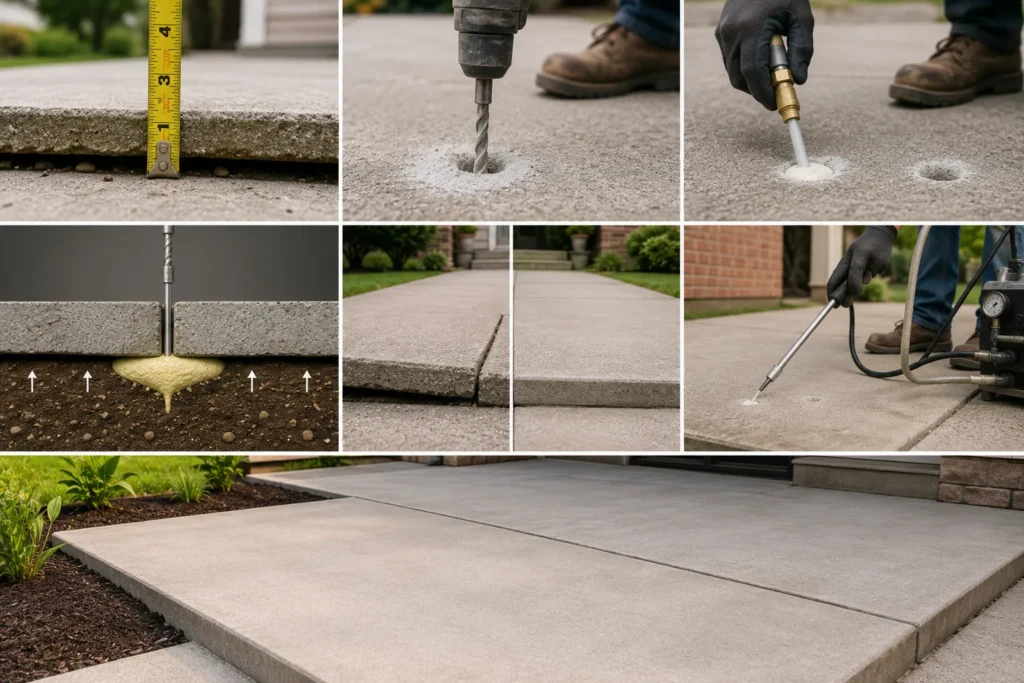
Contractors drill a few small holes, inject either a cement-based slurry or two-part polyurethane foam through them, and the material’s expansion or hydraulic pressure lifts the concrete. The crew then patches the holes with fast-setting concrete repair mortar.
Materials Used in Concrete Raising: Specifications and Standards
Two structural fill materials dominate the industry, and each carries distinct composition, density, and load-rating specifications.
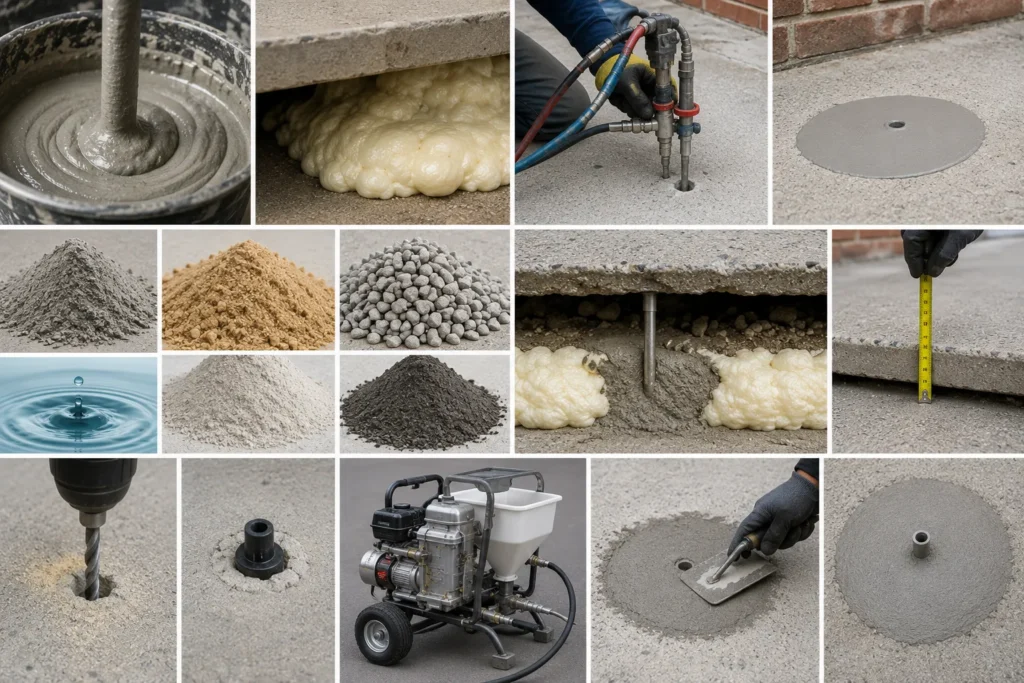
Cement slurry (mudjacking material) is a mix of Portland cement (typically Type I or Type I/II), fine sand, water, and sometimes crushed limestone aggregate or fly ash as a filler. A hydraulic grout pump pushes the slurry under the slab at high pressure. Cured slurry weighs roughly 100 pounds per cubic foot and reaches compressive strength in the 24-48 hour range. Mudjacking material is the industry-standard structural fill material and has been for decades.
Two-part polyurethane foam combines a resin component and an isocyanate activator at the injection gun. The two-part mixture expands within seconds through an exothermic reaction and cures into a rigid, closed-cell, waterproof structural foam. Foam density ranges from 2 to 6 pounds per cubic foot depending on the load-bearing requirement. High-density foam formulations (4-6 lb/cu ft) rated for driveway and structural slab work test above 6,000 pounds per square foot compressive strength (comparable to ASTM C1621 flow and load-rating benchmarks used across the polyurethane construction materials industry). Foam suppliers commonly grade products by application: light-density foam for sidewalks and patios, high-density formulations for driveways and garage floors, and specialty structural-grade foam for load-bearing commercial slabs.
Equipment used in the raising process includes a concrete drill fitted with a ⅝-inch or 2-inch masonry bit, injection ports, a foam dispensing rig or hydraulic grout pump, a fast-setting concrete patch compound, and rapid-set cement mortar for hole finishing. Patch material typically reaches walkable strength in under an hour.
The material specification is the repair. Ask any contractor what foam density grade they use and what the slurry mix ratio is. Keep shopping if a contractor can’t answer with specific figures.
How Does Concrete Raising Work? (Step by Step)
The process is simpler than most people expect. A typical residential job runs 2-4 hours.
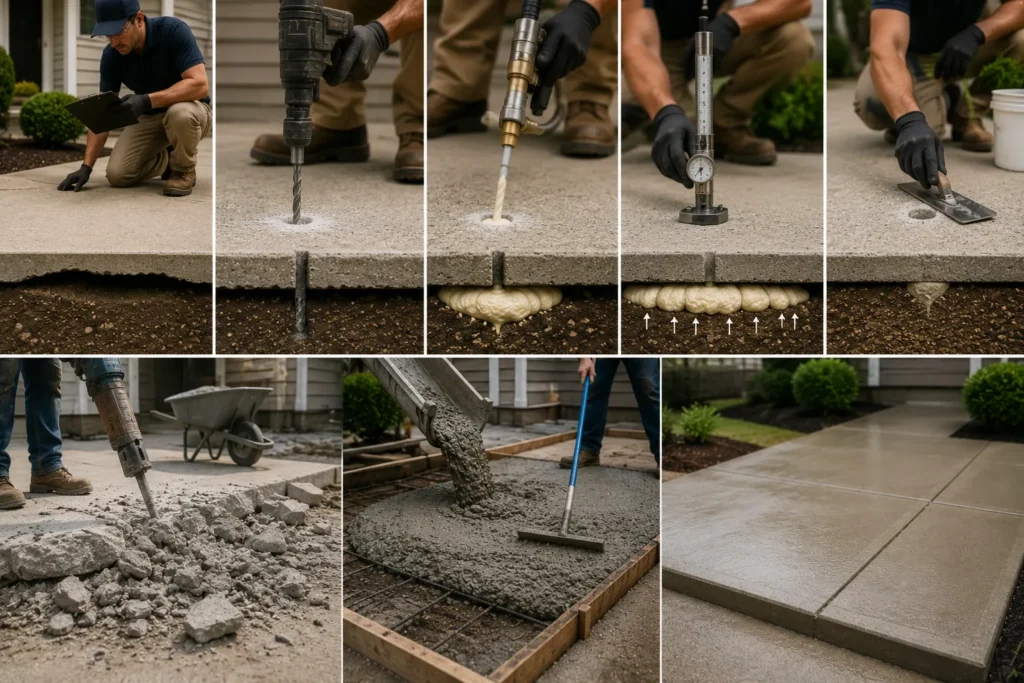
Step 1: Inspection. A technician checks the slab for structural cracks and probes the soil to locate voids. The inspection tells the crew where to drill and how much fill material the job needs.
Step 2: Drilling. For foam jacking, the holes are about the size of a dime — ⅝ inch. Mudjacking needs bigger holes, closer to 2 inches. Fewer, smaller holes mean less patch material and less finishing work later.
Step 3: Injection. Fill material gets pumped under the slab through injection ports. Foam expands within seconds and fills every gap. Cement slurry flows in under hydraulic pressure.
Step 4: Monitoring. The crew watches the slab rise in real time, often to within a tenth of an inch of the target height. Foam hardens in about 15 minutes.
Step 5: Patching. Holes get filled with fresh concrete repair mortar, the crew cleans the site, and the slab is ready for use the same day.
Compare that to replacement: demolition, hauling, forming, pouring new concrete, then a week of waiting for the material to cure. Raising wins on speed alone.
Concrete Raising Methods: Piering as a Fourth Option
Foam and mudjacking fix slab-level settlement — voids directly under a driveway, patio, or sidewalk. Piering addresses a different problem: deeper structural settlement, where the soil beneath a foundation or heavily loaded slab has failed at depth. Contractors drive steel piers through the weak soil down to load-bearing strata, then transfer the slab’s structural load onto the piers. Piering material and labor cost more than foam or mudjacking and applies mainly to garage floors, foundations, or slabs carrying heavy structural loads — not typical driveway or patio settlement. A contractor who inspects your soil should specify whether the job needs piering or standard structural fill raising.
Concrete Raising Cost in 2026
Most homeowners pay $800 to $2,800 for concrete raising in 2026, with the national average sitting around $1,400. Small sidewalk jobs can run as low as $400. Large driveways or pool decks can push past $5,000.
Here’s a realistic breakdown by project type:
| Project | Typical 2026 Cost |
| Sidewalk section | $400 – $900 |
| Front steps or stoop | $500 – $1,200 |
| Patio | $700 – $2,000 |
| Driveway (2-3 slabs) | $1,000 – $3,000 |
| Pool deck | $1,500 – $5,000 |
| Garage floor | $1,200 – $3,500 |
Three factors move the price:
Material. Mudjacking material costs $3-$8 per square foot installed. Polyurethane foam runs $5-$15 per square foot but lasts far longer due to its higher structural performance grade.
Void size. A slab that dropped 3 inches needs significantly more fill material than one that dropped half an inch.
Access. A backyard patio behind a fence takes more labor than a front driveway.
Replacement for the same driveway would cost $4,000 to $10,000 in new concrete, forming, and labor. Raising typically saves 50-70% on material and labor combined.
Mudjacking vs. Polyurethane Foam: Material Performance Compared
Most guides go vague on lifespan numbers. Here are the actual material performance figures.
Mudjacking uses a slurry of Portland cement, sand, and water. It’s the older structural fill material — cheap and effective. But the slurry is heavy, around 100 pounds per cubic foot. That mass presses down on the same weak soil that caused the sinking. Expect a mudjacking repair to hold for 5-10 years before the material re-compresses the soil.
Polyurethane foam weighs about 4 pounds per cubic foot — roughly 96% lighter than cured slurry. The closed-cell foam structure doesn’t stress the soil, resists water absorption, and won’t wash out or break down chemically. A foam lift routinely lasts 20-50 years, often the remaining service life of the slab itself.
Quick material comparison:
| Factor | Mudjacking (cement slurry) | Polyurethane Foam |
| Cost per sq. ft. | $3 – $8 | $5 – $15 |
| Service lifespan | 5 – 10 years | 20 – 50 years |
| Hole size | ~2 inches | ~⅝ inch (dime-sized) |
| Cure time | 24 – 48 hours | 15 minutes |
| Material density | ~100 lbs/cu. ft. | ~4 lbs/cu. ft. |
| Water resistance | No | Yes |
| Compressive strength | Moderate | High (6,000+ psi rated formulations) |
Mudjacking material might be the budget choice if you plan to sell the house in two years. Foam pays for itself in durability if you’re staying put — one structural repair instead of three.
Concrete Raising vs. Replacement vs. Resurfacing
Homeowners actually have four repair options, and most contractors only mention the one they sell.
Raising fixes slabs that sank but are still structurally sound, using injected fill material. Cost: low. Time: hours.
Replacement suits slabs that are crumbling, shattered into small pieces, or sitting on soil that keeps eroding — this requires a full new concrete pour. Cost: high. Time: about a week including cure.
Resurfacing fixes ugly — not sunken. A thin concrete overlay material hides surface cracks and stains but does nothing for height. Pair resurfacing with raising if your slab is both sunken and worn.
Grinding shaves down a raised edge to remove a trip hazard using a diamond-blade concrete grinder. Grinding is cheap but it thins the slab material and only works for small height differences.
Raising is almost always the smarter buy if the slab is in fewer than three or four large pieces and the concrete material itself is structurally sound.
7 Warning Signs Your Concrete Is Sinking
Catch settlement early and you’ll pay hundreds instead of thousands. Watch for these:
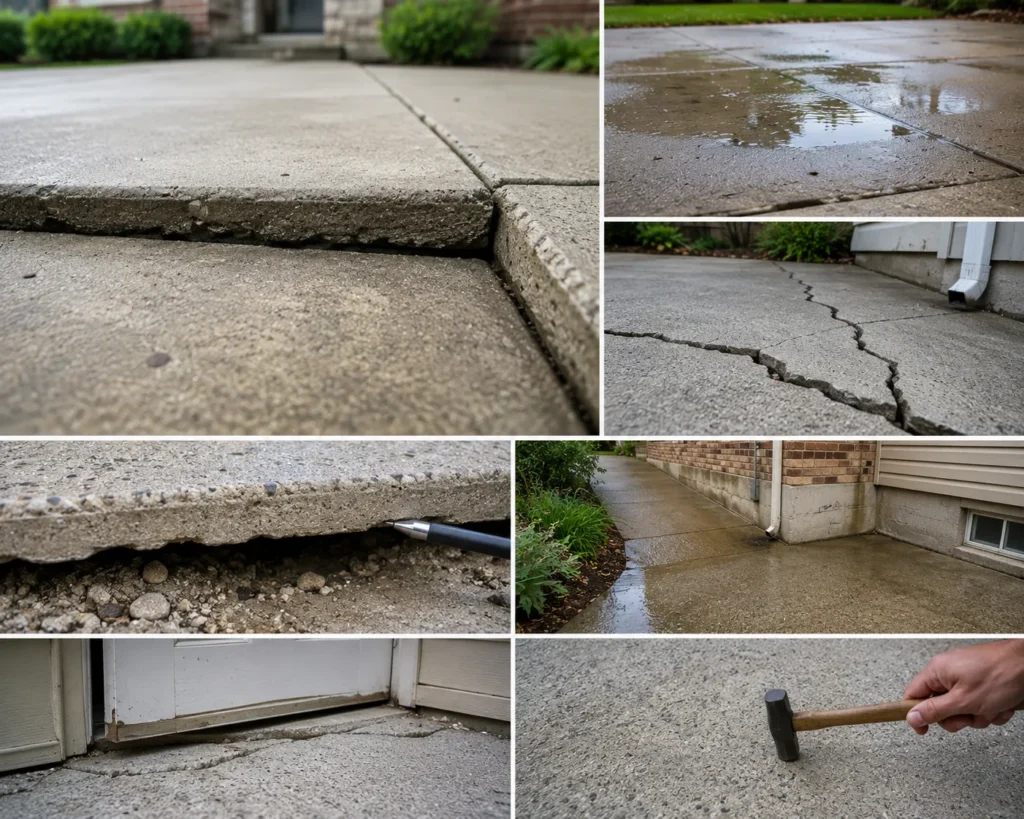
- Uneven slab edges — one section sits higher than its neighbor, even by half an inch.
- Pooling water after rain instead of runoff draining away.
- Widening cracks across a season, especially stair-step cracks.
- Gaps under the slab edge — you can see daylight or slide a stick underneath.
- A slab tilting toward your foundation — water flowing toward the house erodes the soil under your footings.
- Doors or gates that drag where they meet a concrete pad.
- Hollow sounds when you tap the slab — a sign of voids below.
Sign 5 deserves repeating: a driveway sloping toward your home isn’t just a concrete problem. A sloped driveway signals a future foundation problem, and foundation repair starts at ten times the price.
Why Concrete Sinks: It Depends on Where You Live
Soil composition causes sinking, and soil type changes by region. Regional soil variation is why national advice often misses the mark.
Texas, Oklahoma, and the South: expansive clay soil. Clay soil swells when wet and shrinks hard during drought, leaving voids under slabs. The 2025-26 drought cycles made this worse across North Texas.
Florida and the Gulf Coast: sandy soil that washes out fast. Heavy rain carries soil away from under slab edges. Sinkhole-prone areas add another layer of risk.
The Midwest and Northeast: freeze-thaw cycles. Water under the slab freezes, heaves the concrete up, then drops it into a void when it melts. Ten winters of this cycle and a sidewalk looks like a staircase.
California and the West: drought shrinkage plus poorly compacted fill soil under newer developments.
Soil type tells a good contractor whether to just lift the slab with structural fill or also stabilize the soil beneath it. Ask about deep foam injection or drainage fixes in washout-prone areas — otherwise you’re lifting a slab onto the same failing ground.
When Concrete Raising Won’t Work (The Honest Part)
No repair material works everywhere. Raising is the wrong call when:
The slab is shattered. Concrete broken into many small pieces can’t be lifted as a unit. Lifting a shattered slab just spreads the pieces.
The concrete material itself is failing. Crumbling, flaking, or spalling concrete has a material integrity problem, not a soil problem. New fill material won’t fix degraded concrete.
Erosion is active and unaddressed. A slab lifted over soil that’s still washing away will sink again regardless of fill material used. Fix the drainage first.
The slab is too thin or was poured badly. Some builder-grade slabs crack under lifting pressure due to inadequate material thickness or reinforcement.
A trustworthy contractor will tell you when replacement is the better spend. Get a second opinion if someone promises raising fixes everything.
DIY vs. Professional-Grade Materials
Small DIY foam kits exist for hairline settlement on sidewalks or small patio sections — a homeowner injects a light-density consumer-grade foam through a pre-drilled hole. DIY kits work only for minor, cosmetic-level settlement because consumer-grade foam density and compressive strength fall well below commercial structural-fill formulations. Driveways, garage floors, and any slab carrying vehicle weight need contractor-grade material and commercial pressure-injection equipment rated for high-density foam or hydraulic slurry pumping. Under-lifting or over-lifting a structural slab with consumer-grade material and tools can crack the concrete or leave the void only partially filled.
Is Concrete Raising Worth It? Material Performance and Value
Replacement requires roughly $6,500 in new concrete material and labor, one week of no driveway, and a fresh pour on the same unstable soil.
Foam raising costs roughly $1,800 in material and labor, finishes by lunch, delivers a 20+ year material lifespan, and addresses the underlying soil void.
Raising wins for any structurally sound slab. Here’s both sides of the material trade-off, laid out straight.
The Pros
- Costs 50-70% less than replacement material and labor.
- Structural fill material sets fast — most jobs finish before lunch, and foam-lifted slabs take traffic the same day.
- No demolition. No jackhammers, no material hauling, no ruined landscaping.
- Your original concrete matches. New pours never match the color or aggregate of existing slabs.
- Raising keeps roughly two tons of concrete material out of a landfill per project and skips the carbon cost of a fresh cement pour.
- A quality foam or slurry fill addresses the soil void that caused the sinking in the first place.
The Cons
- Existing surface cracks stay visible. Raising restores height, not surface appearance.
- Not every slab qualifies. Shattered, crumbling, or badly poured concrete needs a full material replacement.
- Outcome depends on soil condition. The slab can settle again if active erosion isn’t addressed before the fill material goes in.
- Material and workmanship quality vary by contractor. An inexperienced crew can over-lift a slab and crack it.
The main risk is a contractor using the wrong material grade or density for the job. Get a contractor who inspects the soil, specifies the exact material and density rating for your slab, and puts a material warranty in writing.
The Bottom Line on Concrete Raising
Sunken concrete doesn’t fix itself. The voids under your slab only grow, and every season of rain or frost drops it a little lower. Wait too long and a $900 material lift becomes a $6,000 full replacement — or worse, a foundation repair.
Concrete raising is the smartest material investment for a slab that’s structurally sound but sitting low. Polyurethane foam outperforms cement slurry in service life by decades. Expect to pay $800 to $2,800 for most residential jobs in 2026, using contractor-grade fill material rated for the load your slab carries. Ask a contractor for the material or soil reason if they push replacement without explaining why raising won’t work.
A few dime-sized holes, contractor-grade structural fill material, and your original concrete back where it belongs. That’s the material science behind concrete raising, and the performance numbers back it up.