
Concrete takes 28 days to reach full cure strength — but that does not mean it is unusable for 28 days. Foot traffic is safe after 24 to 48 hours. Vehicles can use the surface after 7 days. The 28-day mark is when concrete hits 100% of its design compressive strength (PSI), not when it first becomes hard.
Most homeowners confuse curing with drying. Drying is water evaporating from the surface. Curing is a chemical reaction inside the concrete called hydration — where Portland cement bonds with water molecules to form calcium silicate hydrate (C-S-H) gel, the compound that gives concrete its strength. These are 2 separate processes, and confusing them causes premature loading, cracking, and reduced lifespan.
Rainy Roofers handles concrete work on every roof installation project — from poured concrete deck flashings to foundation repairs before reroofing. Understanding cure timelines protects both the structure and your investment.
Concrete Curing vs. Concrete Drying — 2 Different Things
Curing is a chemical process. Drying is physical water loss. Concrete cures through hydration — cement reacts with water to form hardened crystals. This reaction requires moisture to continue. If the surface dries out too fast, hydration stops early and the concrete reaches only a fraction of its design strength.
Drying, on the other hand, is the evaporation of excess water from the slab. A 4-inch (10 cm) concrete slab can take 3 to 12 months to fully dry out — long after the 28-day cure benchmark. For most exterior projects like driveways, patios, and footings, drying time is less critical than curing time. For interior floors with moisture-sensitive coatings or flooring, drying matters significantly.
The practical rule: never let newly poured concrete dry out in the first 7 days. Keeping it moist during this period is the single most effective step a contractor or homeowner can take to maximize concrete strength.
How Long Does Concrete Take to Cure — By Project Type
Cure requirements differ based on what the concrete must support and how soon.
Concrete Driveway Cure Time
Wait 7 days before driving a standard passenger vehicle on a new concrete driveway. Wait 28 days before parking heavy trucks, SUVs over 5,000 lbs (2,268 kg), or construction equipment. Driving on concrete before 7 days risks surface cracking, tire impressions, and reduced long-term strength in the top layer.
Most concrete driveways use a 4,000 PSI mix. At 7 days in moderate temperatures (55 – 70°F / 13 – 21°C), this mix reaches approximately 2,600 PSI — sufficient for a standard 4,000 lb (1,814 kg) passenger vehicle. Below 40°F (4°C), that same 7-day concrete may only reach 1,200 – 1,600 PSI, making early loading genuinely risky.
Concrete Sidewalk and Walkway Cure Time
Foot traffic is safe after 24 to 48 hours on a properly poured concrete walkway. Avoid heavy tools, bicycles, or concentrated loads during the first 48 hours. At 24 hours, the concrete surface has enough strength to resist foot traffic without permanent indentation — but dragging equipment or rolling heavy items across it will still leave marks.
Concrete Footing and Foundation Cure Time
Concrete footings and foundation walls need a minimum 7-day cure before applying structural loads. Most residential building codes require 28 days before a foundation wall supports a floor system. Contractors in cold climates add insulated concrete blankets to maintain temperatures above 40°F (4°C) during curing — especially critical for footings poured in fall or early spring.
For roofing projects, concrete chimney bases, parapet wall caps, and roof deck flashings poured in sections need 48 to 72 hours minimum before receiving any load or sealant application. A properly cured concrete base under roof repair work lasts decades longer than one sealed too early.
Concrete Patio Cure Time
A concrete patio handles light foot traffic after 48 hours and full outdoor furniture after 7 days. Avoid dropping heavy planters, grills, or furniture with concentrated leg loads before the 7-day mark. At 28 days, the patio reaches full design strength and handles any normal residential load indefinitely.
4 Factors That Change How Long Concrete Takes to Cure
These 4 variables determine whether your concrete reaches design strength in 28 days or takes significantly longer.
1. Temperature
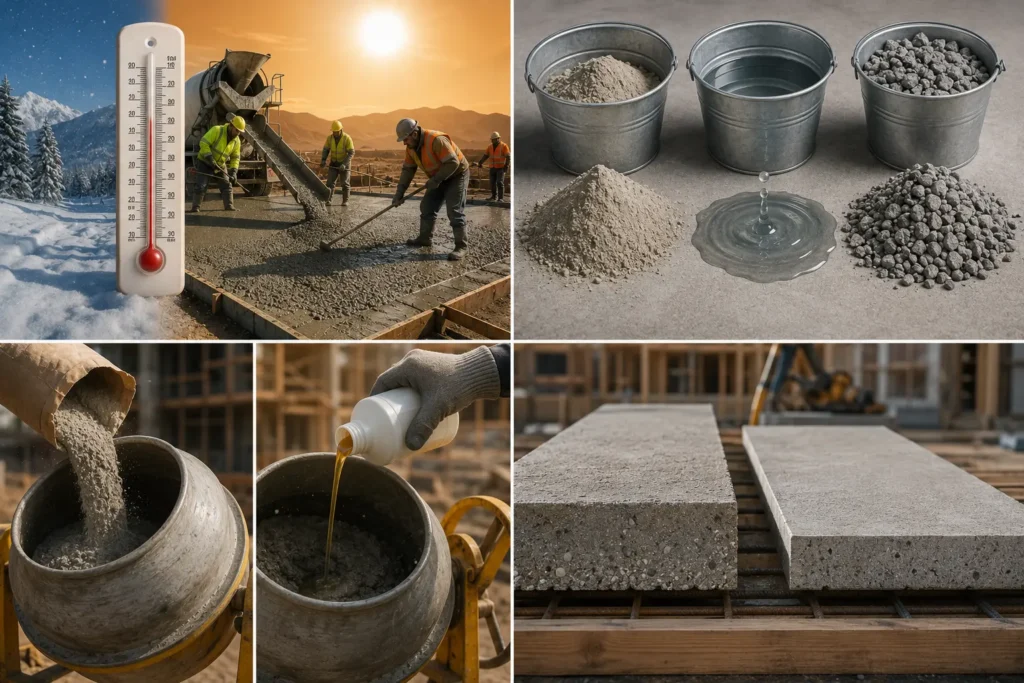
Temperature is the single biggest variable in concrete cure time. Ideal curing temperature is 55 – 90°F (13 – 32°C). Outside this range, curing slows or fails.
| Air Temperature | Temp Factor | 7-Day Strength (4000 PSI) | Impact |
| Above 70°F (21°C) | 1.00 | ~2,600 PSI | Ideal — standard cure |
| 50 – 70°F (10 – 21°C) | 0.85 | ~2,210 PSI | Slightly slower |
| 40 – 50°F (4 – 10°C) | 0.65 | ~1,690 PSI | Significantly slower |
| Below 40°F (4°C) | 0.40 | ~1,040 PSI | Curing nearly halted |
| Below 27°F (-3°C) | — | Freeze damage | Hydration stops — cracking likely |
Every 10°F (5.5°C) drop in temperature roughly doubles the time concrete needs to reach a given strength level. A contractor pouring in Minneapolis in October uses heated enclosures, insulated blankets, and hot water in the mix to keep the concrete above 50°F (10°C) for the first 48 hours minimum.
Hot weather creates the opposite problem. Above 90°F (32°C), water evaporates from the surface before hydration completes — producing a concrete that looks fully set but has 15 to 20% less long-term strength than the same mix cured in moderate temperatures. Contractors in Phoenix, Las Vegas, and Houston pour in early morning hours and cover slabs with wet burlap or curing compound immediately after finishing.
2. Water-Cement Ratio
A lower water-cement (w/c) ratio produces stronger concrete but requires more careful curing to prevent premature drying. Standard residential concrete uses a w/c ratio of 0.45 to 0.60. High-strength mixes drop to 0.35 – 0.40. At lower ratios, there is less free water available for hydration — meaning the concrete must be kept moist externally to sustain the chemical reaction through 28 days.
Adding excess water to a ready-mix truck to improve workability is one of the most common jobsite errors. Each gallon (3.8 liters) of water added beyond the design ratio reduces compressive strength by approximately 200 to 300 PSI.
3. Cement Type and Admixtures
Type III cement cures 40 to 50% faster than standard Type I cement. Type III reaches 70% strength in 3 days instead of 7. Contractors use Type III in cold-weather pours, fast-track construction schedules, and precast applications.
Calcium chloride accelerator admixtures cut cure time further — commonly used in cold weather concrete work. Retarder admixtures slow the set time for hot weather pours or large slab placements where early stiffening creates cold joints. Neither admixture changes the 28-day full-strength benchmark — only the rate at which the concrete gets there.
4. Slab Thickness
Thicker slabs cure at the same rate as thinner ones — thickness does not extend the 28-day timeline. A 6-inch (15 cm) slab and a 4-inch (10 cm) slab both reach full strength at 28 days under the same conditions. Thickness does affect how long the center of a mass pour retains heat — which can accelerate curing in the core while the surface cures more slowly, creating thermal gradients that cause cracking in very large pours.
How to Cure Concrete Properly — 4 Methods
Proper curing means maintaining adequate moisture and temperature from the moment concrete is poured through the first 7 days minimum.
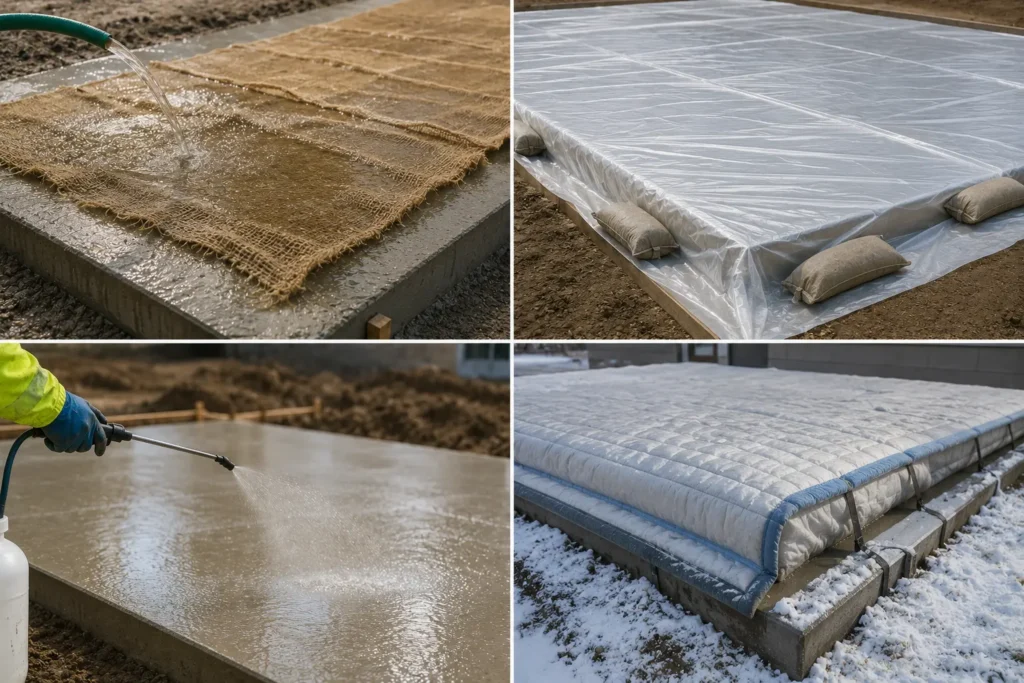
- Wet curing — Wet curing (best method): Keep the concrete surface continuously moist using wet burlap, cotton mats, or absorptive fabric covered with plastic sheeting. The American Concrete Institute (ACI) 308 guide identifies 7 days of continuous wet curing as the most reliable method for standard Type I cement mixes.
- Plastic sheeting — Plastic sheeting: Cover the finished surface with 4-mil (0.1 mm) polyethylene plastic sheeting to trap surface moisture. Seal all edges with tape or sandbags. Plastic sheeting is the most practical method for residential driveways and patios — no watering required after the initial placement.
- Curing compound — Curing compound: Spray a liquid curing membrane (ASTM C1315 Type II for exterior use) immediately after finishing the surface. The compound forms a film that seals in moisture for 7 to 14 days as the concrete cures beneath it. Do not apply curing compound to surfaces that will receive bonding agents or coatings — the film prevents adhesion.
- Insulated blankets — Insulated blankets (cold weather): Lay insulated concrete curing blankets over the slab to maintain surface temperature above 50°F (10°C) during cold weather pours. Blankets add 10 to 20°F (5.5 – 11°C) to the curing temperature and are standard practice for fall and early spring pours in northern US states.
Cold Weather Concrete Curing — What Changes
Never pour concrete when the air temperature is below 40°F (4°C) without protective measures. The American Concrete Institute (ACI) defines cold weather as any period where air temperature drops below 40°F during the protection period — typically the first 1 to 6 days after placement.
At 25 to 27°F (-4 to -3°C), pore water inside curing concrete begins to freeze. Ice crystals forming inside the concrete matrix physically disrupt the hydration bonds — causing cracking, reduced strength, and permanent damage that no amount of additional curing can reverse. A concrete slab that freezes before reaching 500 PSI almost always requires complete removal and replacement.
Cold weather protection measures include: using hot water in the mix, requesting Type III (high-early-strength) cement, applying insulated blankets for the first 48 hours, enclosing the pour area with heated enclosures, and monitoring concrete temperature with embedded sensors.
For homeowners in the northern USA — Minnesota, Wisconsin, Michigan, New York, and New England states — fall pours after October 15 and spring pours before April 15 require at minimum insulated blanket coverage for the first 48 hours after placement.
Hot Weather Concrete Curing — What Changes
Concrete poured above 90°F (32°C) air temperature sets too fast and loses strength. High heat accelerates the hydration reaction, generating internal heat that causes thermal cracking. Simultaneously, water evaporates from the surface faster than hydration can use it — leaving the mix water-deficient before the reaction completes.
Hot weather mitigation steps: pour in early morning (before 7 AM in Phoenix, Dallas, or Las Vegas), use chilled mixing water, add ice to the mix water to lower concrete temperature at placement, apply evaporation retarder spray immediately after screeding, and begin wet curing or plastic sheeting within 20 minutes of finishing. The target concrete temperature at placement is 50 to 75°F (10 – 24°C) — achievable even in summer with the right pre-pour preparation.
Concrete Curing Time Chart — By Temperature
| Condition | 24 hrs | 7 days | 28 days | Notes |
| Ideal (55–90°F / 13–32°C), wet cure | 20–30% | 70% | 100% | Standard residential |
| Warm (70–90°F / 21–32°C), no cover | 25–35% | 65% | 90–95% | Cover for best results |
| Cool (40–55°F / 4–13°C) | 10–20% | 45–55% | 85–90% | Extend wet curing to 10 days |
| Cold (<40°F / <4°C) | 5–10% | 25–40% | 60–75% | Blankets required |
| Hot (>90°F / >32°C), unprotected | 30–40% | 55–65% | 80–85% | High cracking risk |
7 Mistakes That Ruin Concrete Cure — And How to Avoid Them
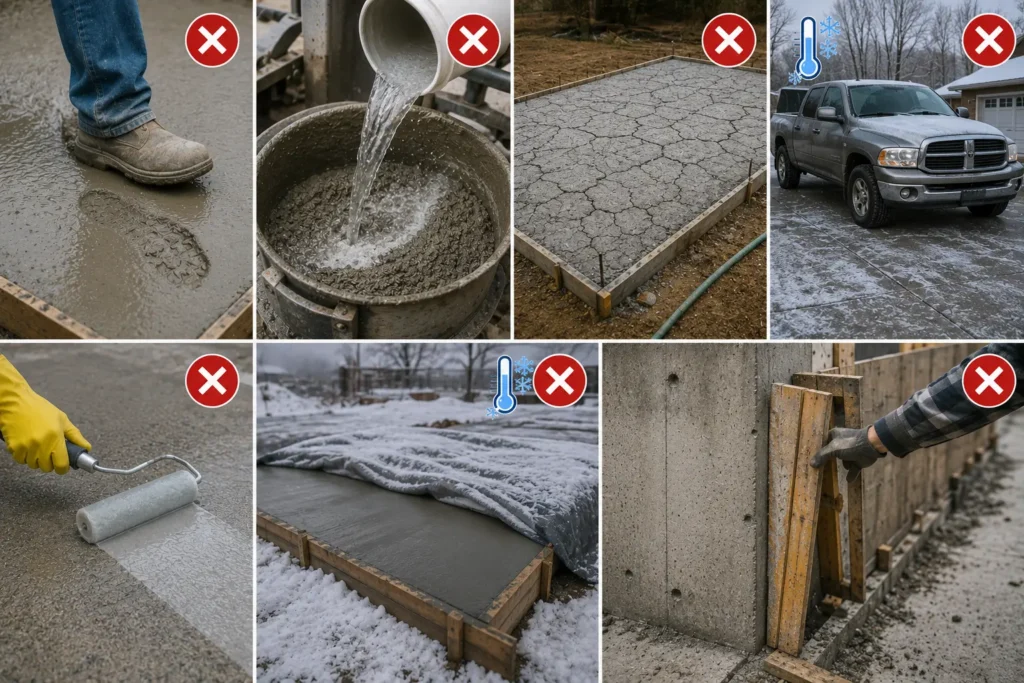
- Walking too early — Walking on concrete before 24 hours passes. Foot impressions at 12 hours are permanent. The surface has no strength before initial set is complete.
- Over-watering the mix — Adding water to the mix at the jobsite. Every extra gallon per cubic yard loses 200 to 300 PSI of design strength. Never dilute ready-mix concrete to improve workability.
- Skipping moisture retention — Letting the surface dry out in the first 7 days. Hydration stops without moisture. Cover all concrete immediately after finishing.
- Loading too early in cold weather — Parking heavy vehicles at the 7-day mark in cold weather. In temperatures below 50°F (10°C), wait 14 days minimum before vehicle traffic.
- Sealing too early — Applying sealers before 28 days. Most penetrating sealers and coatings require fully cured concrete. Applying before 28 days traps residual moisture and causes delamination.
- Cold-weather pours without blankets — Pouring in freezing temperatures without protection. Below 27°F (-3°C) freezes the pore water and stops hydration permanently — the slab never reaches design strength.
- Stripping forms prematurely — Removing forms too early. Wall forms should stay in place for 24 to 48 hours minimum. Footing forms: 24 hours. Structural wall forms: 12 to 24 hours depending on design load.
When Concrete Relates to Roofing Work
Concrete appears in roofing projects more often than most homeowners realize — chimney bases, parapet wall caps, concrete tile underlayments, and flat roof deck sections all involve poured or precast concrete that must be properly cured before roofing work proceeds.
A wet or improperly cured concrete surface under a roofing system creates moisture migration into insulation, premature membrane failure, and adhesive bonding failures. Rainy Roofers’ commercial roofing team verifies concrete substrate moisture levels before installing any adhered roofing system — because even visually dry concrete holds significant moisture below the surface for weeks after the 28-day cure mark.
Storm damage that impacts concrete roof components — cracked parapet caps, spalled chimney bases, damaged concrete tile — needs proper repair and rehydration before roof repair work proceeds over it. Loading new roofing onto weakened or uncured concrete causes long-term structural problems that void most roofing warranties.
Regular roof maintenance inspections include checking the concrete components of a roofing system — not just the membrane or shingles — because concrete deterioration is a leading source of hidden moisture intrusion that goes undetected until a major repair is needed.
Conclusion
Concrete cures in a predictable sequence — 24 to 48 hours for foot traffic, 7 days for vehicles, 28 days for full design strength. Temperature, water-cement ratio, cement type, and curing method determine whether concrete reaches that strength on schedule or falls short.
The 2 most common mistakes are loading concrete too early and letting it dry out in the first week. Both are easily avoided: cover the slab, maintain moisture for 7 days, and respect the load timeline based on actual temperature conditions — not just calendar days.
For any roofing project involving concrete components, proper cure time is not optional. Premature loading or sealing a concrete substrate shortens the life of everything installed above it. If you have questions about concrete conditions affecting your roof, Rainy Roofers’ team assesses substrate readiness as part of every pre-installation inspection.