
Every construction project comes down to one cement decision: OPC or PPC. Most builders pick based on availability or habit. That works until a slab cracks, a parapet wall develops hairline fractures, or a coastal foundation shows early deterioration. Each of those failures traces back to using the wrong cement for the conditions.
OPC (Ordinary Portland Cement) and PPC (Portland Pozzolana Cement) are the 2 most used cement types in construction. Both bind concrete and mortar. Both meet IS and ASTM standards. But they behave differently at 7 days, 28 days, and 90 days — and that difference matters in columns, foundations, roof slabs, plaster, and masonry work.
This guide gives you 15 direct comparisons, a strength timeline table, element-by-element selection guide, climate zone recommendations, mixing ratios, and a final decision table — everything needed to pick the right cement before the truck arrives on site.
What Is OPC Cement?
OPC is made from 95% clinker and 5% gypsum — ground to a fineness of 225–300 m²/kg. Clinker is produced by heating limestone and clay at 2,640°F (1,450°C) in a rotary kiln. Gypsum controls setting time by retarding the rapid hydration of tricalcium aluminate (C₃A).
OPC is available in 3 grades:
- OPC 33: 33 N/mm² (4,786 psi) at 28 days — low-stress masonry and plastering
- OPC 43: 43 N/mm² (6,236 psi) at 28 days — general RCC, floors, foundations
- OPC 53: 53 N/mm² (7,687 psi) at 28 days — precast, prestressed, high-rise RCC
Key chemical compounds in OPC:
- C₃S (Tricalcium Silicate): 45–65% — responsible for early strength
- C₂S (Dicalcium Silicate): 15–30% — responsible for long-term strength
- C₃A (Tricalcium Aluminate): 6–12% — causes rapid initial set, sulphate vulnerability
- C₄AF (Tetracalcium Aluminoferrite): 8–13% — minor strength contribution
- Gypsum: 3–5% — retards flash set
- IS Code: IS 269:2015
- ASTM equivalent: Type I, II, III Portland Cement
OPC is commonly used in roof slab construction. Our roof installation services include substrate preparation over OPC concrete decks.
What Is PPC Cement?
PPC replaces 15–35% of OPC clinker with pozzolanic materials — fly ash (most common), volcanic ash, or calcined clay. Pozzolanic materials are silica-rich substances that react with calcium hydroxide (Ca(OH)₂) released during OPC hydration.
This secondary reaction produces additional C-S-H gel — filling capillary pores, reducing permeability, and improving long-term strength. The reaction is slow: it accelerates between 28 and 90 days, which is why PPC’s long-term strength often exceeds OPC.
Key composition:
- Portland clinker: 65–85% by weight
- Fly ash / pozzolana: 15–35% by weight
- Gypsum: 3–5%
- 28-day strength: 25–33 N/mm² (minimum)
- IS Code: IS 1489:2015 Part 1 (fly ash) / Part 2 (calcined clay)
- ASTM equivalent: No direct equivalent; closest is blended cement ASTM C595 Type IP
- CO₂ reduction: PPC produces 20–30% less CO₂ per ton than OPC because fly ash replaces clinker — and clinker production accounts for 90% of cement’s carbon footprint. PPC uses an industrial waste (fly ash from coal power plants) as a raw material, diverting it from landfills.
OPC vs PPC Cement: 15 Key Differences
| Property | OPC | PPC | Winner |
|---|---|---|---|
| Raw materials | 95% clinker + 5% gypsum | 65-85% clinker + 15-35% fly ash + gypsum | — |
| 7-day strength | 65–75% of 28-day value | 50–60% of 28-day value | OPC |
| 28-day strength | 43–53 N/mm² | 25–33 N/mm² | OPC |
| 90-day strength | Marginal gain after 28 days | Continues increasing 10–20% | PPC |
| Setting time (initial) | 30 min minimum | 30 min minimum (slower in practice) | OPC (faster) |
| Heat of hydration | 80–90 cal/g at 7 days | 60–70 cal/g at 7 days | PPC |
| Workability | Standard | Better (fly ash acts as lubricant) | PPC |
| Sulphate resistance | Low | Moderate | PPC |
| Chloride resistance | Standard | Better (denser matrix) | PPC |
| Crack resistance | Lower (higher shrinkage) | Higher (lower heat, less shrinkage) | PPC |
| Plaster finish quality | Good | Better (smoother finish) | PPC |
| Cost (50 kg bag) | $8–$14 USD | $7–$12 USD | PPC |
| Eco-friendliness | High CO₂ | 20-30% lower CO₂ | PPC |
| Shelf life | 3 months | 3 months | Equal |
| IS Code | IS 269:2015 | IS 1489:2015 | — |
OPC vs PPC Strength Development Over Time
This is the most important data point competitors miss. Strength is not a single number — it develops over time differently for OPC and PPC.
| Age | OPC 43 (N/mm²) | OPC 53 (N/mm²) | PPC (N/mm²) | Notes |
|---|---|---|---|---|
| 1 day | 10–14 | 14–18 | 5–8 | OPC leads by 2x at 1 day |
| 3 days | 23–27 | 27–32 | 12–18 | OPC leads by 50–60% |
| 7 days | 30–35 | 37–42 | 22–28 | OPC still ahead — safe formwork removal |
| 28 days | 43+ | 53+ | 25–33 | OPC peak grade strength |
| 90 days | Marginal gain | Marginal gain | 33–40 | PPC closes the gap significantly |
| 1 year | Stable | Stable | 38–45 | PPC may exceed OPC 43 at this point |
Key insight: PPC at 90 days reaches strength comparable to OPC 43 at 28 days. For non-critical elements where 90-day curing is acceptable, PPC delivers OPC-level strength at lower cost and with better durability.
Concrete roof slabs need adequate curing before roofing installation. Our roof inspection services verify substrate readiness before any membrane or metal panel installation.
Heat of Hydration: Why It Matters for Construction
Heat of hydration is the heat released when cement reacts with water. Excess heat in thick concrete sections causes a temperature differential between the hot interior and cooler surface — generating tensile stresses that crack concrete from within.
OPC generates 80–90 cal/g at 7 days. PPC generates 60–70 cal/g. The 25% reduction in heat makes PPC the correct choice for:
- Slabs thicker than 12 inches (300 mm)
- Raft foundations and pile caps
- Large retaining walls
- Bridge abutments and dam sections
- Any pour where the temperature differential exceeds 35°F (20°C)
Practical rule: Use PPC for any concrete element where the smallest dimension exceeds 24 inches (600 mm). Use either OPC or PPC for thinner elements.
Which Cement to Use — Element by Element
This section is the core competitor gap. No existing article gives a direct element-by-element decision guide.
Foundation
Use PPC — foundations are mass pours (thick sections), often in contact with soil that contains sulphates, and require long-term durability over fast strength. Water-cement ratio: 0.45 maximum. Curing: 14 days minimum.
RCC Columns and Beams
Use OPC 43 or OPC 53 — high early strength allows formwork removal at 3–7 days, speeding up construction. M25 grade concrete (1:1:2 ratio or design mix). OPC 53 for column concrete above M30 grade.
Column and beam concrete requires proper curing before any roofing structure is erected. Our roof replacement specialists work with contractors on new construction and re-roofing projects.
Roof Slab (RCC Terrace)
Use OPC 43 for fast construction timelines; use PPC for humid climates with no time pressure. M20 minimum grade (1:1.5:3 or design mix). Water-cement ratio: 0.45 maximum for waterproof terrace slab. Curing period: OPC — 7 days; PPC — 14 days minimum.
Plastering (Internal and External)
Use PPC — fly ash improves workability and produces a smoother, crack-free finish. External plaster mix: 1:4 (cement:sand). Internal plaster: 1:5 or 1:6. PPC plaster shrinks less than OPC plaster because of lower heat generation and better particle packing.
Brick Masonry
Use PPC — better bond with brick units, reduced water demand, and lower cost make PPC the standard for masonry work. Mix ratio: 1:6 (cement:sand) for load-bearing masonry, 1:8 for partition walls.
Tile Bedding
Use OPC 43 — faster setting allows tile grouting within 24 hours. Bed thickness: 12–15 mm (0.5 inch). Mix ratio: 1:3 (cement:sand). Use white cement for tile grout, not gray OPC.
Waterproofing Screed on Terrace
Use OPC 43 with waterproofing admixture (crystalline compound at 1–2% by weight of cement). Screed slope: 1:50 minimum (2%) toward roof drains. Thickness: 50 mm (2 inches) minimum.
Waterproofing screed protects the roof slab. For complete flat roof membrane systems over concrete, our commercial roofing services install TPO, EPDM, and modified bitumen systems.
OPC vs PPC by US Climate Zone
Climate directly affects which cement performs better long-term. 4 US climate conditions require specific consideration:
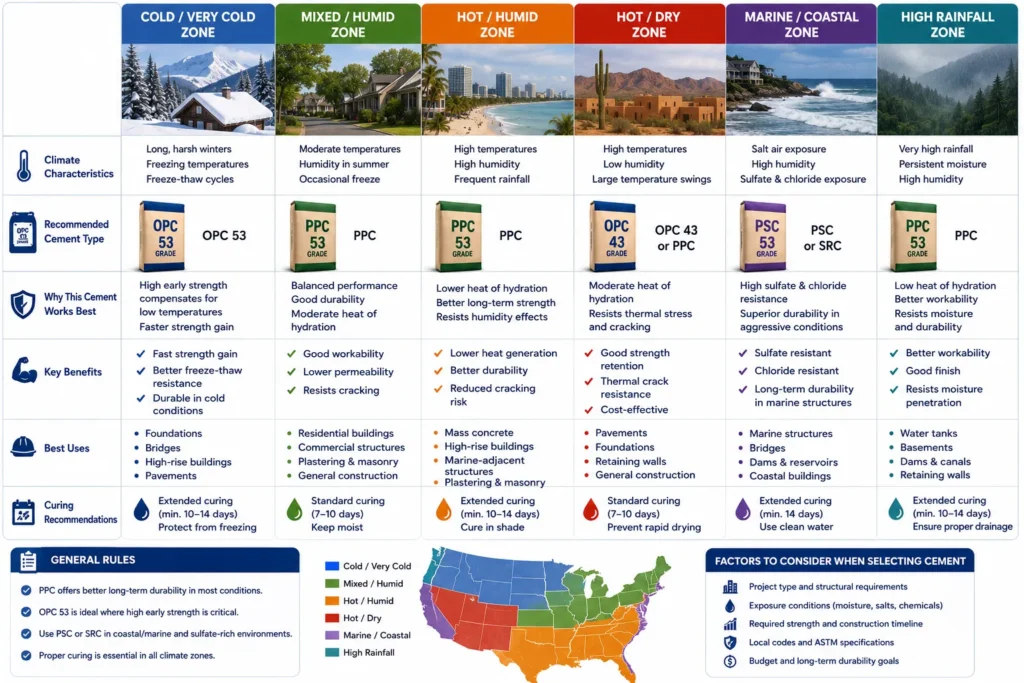
Hot and Humid (Southeast: Florida, Louisiana, Georgia)
PPC is strongly preferred — lower heat of hydration reduces thermal cracking in the hot climate. Better sulphate resistance handles the organic-acid-rich soils of the Southeast. Higher long-term strength resists the carbonation accelerated by high CO₂ in warm, wet conditions.
Coastal (Within 5 miles of saltwater)
PPC minimum; PSC preferred — PPC’s denser matrix reduces chloride diffusion by 40–50% versus OPC. For bridge structures, marine piles, and sea walls, specify Portland Slag Cement (PSC) for maximum chloride resistance.
Cold Weather (Northeast, Midwest: below 40°F / 4°C)
OPC 53 is preferred — PPC’s slow pozzolanic reaction nearly stops below 50°F (10°C). OPC 53’s faster hydration provides adequate early strength before nighttime temperature drops. Add non-chloride accelerators to OPC concrete when ambient temperature falls below 40°F.
Hot and Dry (Southwest: Arizona, Nevada, New Mexico)
Either cement with proper curing — the primary challenge is rapid moisture evaporation from fresh concrete, not cement type. Cover all fresh concrete with wet burlap or curing compound within 20 minutes of finishing. Extended wet curing (14 days) is more important than cement type selection in arid climates.
Roofing in hot climates needs proper deck preparation. Our roof maintenance services identify concrete deck deterioration early, before membrane failure occurs.
OPC vs PPC Cost Comparison (2026)
Cost difference is real but smaller than most people assume. The total cost decision depends on more than bag price.
| Cost Factor | OPC | PPC | Notes |
|---|---|---|---|
| 50 kg bag price (US market) | $8–$14 | $7–$12 | PPC saves $1–$2 per bag |
| Bags per cubic yard of M20 concrete | ~6.5 bags | ~6.5 bags | Mix ratio same |
| Cost per cubic yard (material only) | $52–$91 | $46–$78 | PPC ~10–15% cheaper |
| Curing cost (water + labor) | 7 days standard | 14 days (more water cost) | OPC cheaper to cure |
| Long-term repair probability | Higher in humid/sulphate zones | Lower | PPC saves $$ long-term |
| Cement per 1,000 sq.ft of M20 slab (4″) | ~130 bags | ~130 bags | Same quantity |
| Total cement cost per 1,000 sq.ft slab | $1,040–$1,820 | $910–$1,560 | PPC saves $130–$260 |
Bottom line: PPC saves 10–15% on material cost and significantly reduces repair probability in humid, coastal, and sulphate-bearing soil conditions. OPC’s only cost advantage is shorter curing time — saving 7 days of curing labor and water.
OPC vs PPC Mixing Ratios by Application
| Application | Cement Grade | Mix Ratio (C:S:A) | Water-Cement Ratio | Notes |
|---|---|---|---|---|
| Foundation (M20) | OPC 43 or PPC | 1:1.5:3 | 0.45–0.50 | Compact thoroughly |
| Column/Beam (M25) | OPC 43 or OPC 53 | 1:1:2 | 0.40–0.45 | Vibrate well |
| Roof Slab (M20) | OPC 43 or PPC | 1:1.5:3 | 0.45 max | Low W/C = watertight |
| Plaster (external) | PPC | 1:4 | 0.50–0.55 | 2 coats: 12mm + 8mm |
| Plaster (internal) | PPC | 1:5 or 1:6 | 0.55–0.60 | 1 coat: 12mm |
| Masonry mortar | PPC | 1:6 | 0.55–0.65 | Add plasticizer if needed |
| Waterproofing screed | OPC 43 + admixture | 1:3 | 0.40–0.45 | Slope 1:50 min |
| Tile bedding | OPC 43 | 1:3 | Dry semi-stiff mix | Set tiles within 30 min |
Can OPC and PPC Be Mixed Together?
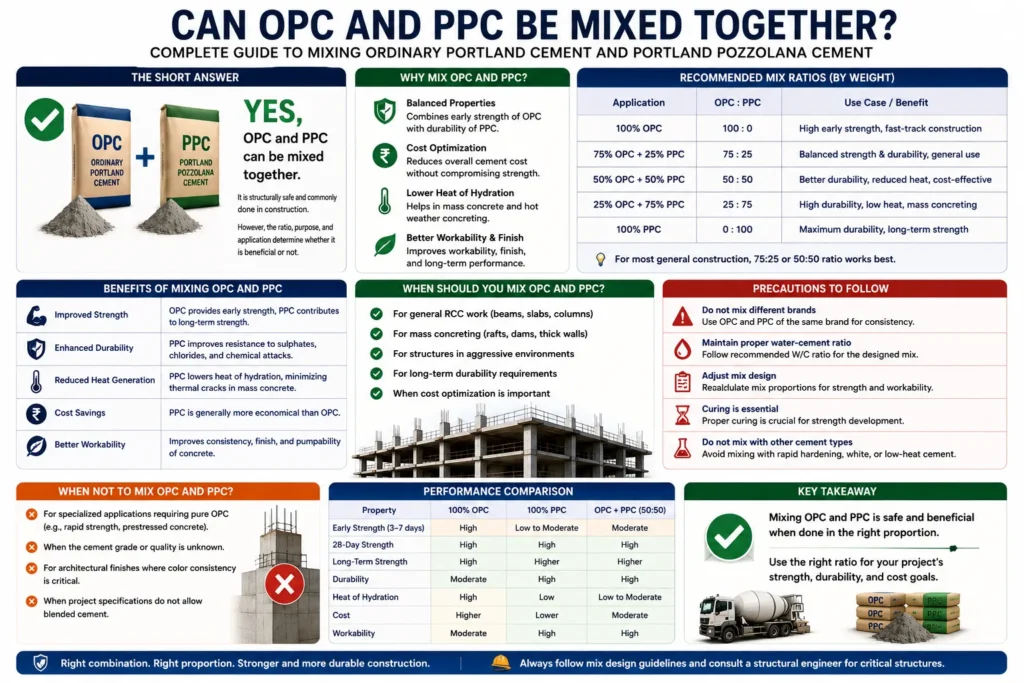
Yes — OPC and PPC can be mixed, but it reduces the benefit of using either cement correctly. Mixing OPC and PPC at the site changes both the heat of hydration and the pozzolanic reaction in unpredictable proportions.
The only practical reason to mix: when only one type is available and the project needs a middle ground. A 50:50 blend produces approximate heat of hydration of 70–75 cal/g and 28-day strength of 35–40 N/mm².
Never mix OPC and PPC for: structural RCC work, waterproofing screeds, or marine structures. The unpredictable sulphate resistance in mixed batches creates a weak point in chemically aggressive environments.
OPC vs PPC for Roofing Applications
Roofing connects directly to cement selection in 4 areas. This section is unique to RainyRoofers.com — no competitor addresses roofing-specific cement guidance.
Concrete Roof Deck (Flat Terrace)
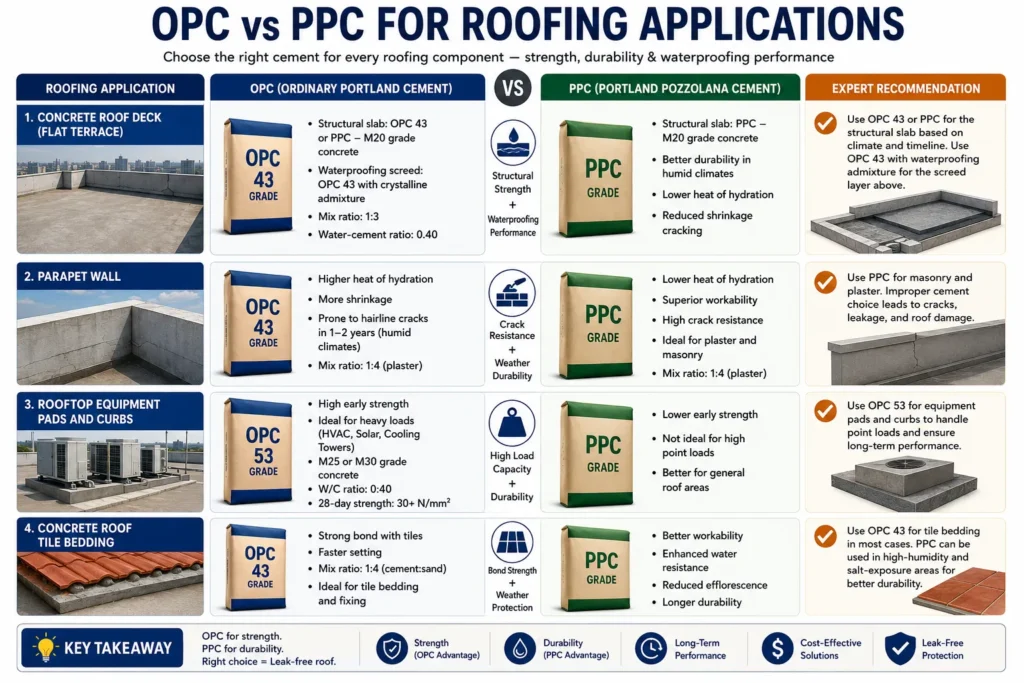
OPC 43 or PPC for the structural slab; OPC 43 for the waterproofing screed above it. The structural slab needs M20 concrete (OPC or PPC). The waterproofing screed on top uses OPC 43 with crystalline admixture at 1:3 mix ratio and 0.40 water-cement ratio.
Parapet Wall
PPC for masonry and plaster — parapet walls are thin, exposed to rain on both faces, and need crack resistance. OPC parapet plaster develops hairline cracks within 1–2 years in humid climates due to high shrinkage. PPC plaster with 1:4 mix and proper curing eliminates 80% of parapet plaster cracks.
Cracked parapet walls allow water into the roof structure. Our roof repair team repairs parapet wall cracks and failed flashing before membrane systems are installed.
Rooftop Equipment Pads and Curbs
OPC 53 for high-load equipment pads — HVAC units, solar panel supports, and cooling towers impose point loads requiring M25 or M30 concrete. OPC 53 at 0.40 water-cement ratio achieves 28-day strength of 30+ N/mm² for M30 design mix.
Concrete Roof Tile Bedding
OPC 43 for tile adhesive bed — faster setting allows traffic on the tile surface within 24 hours. PPC takes 48–72 hours to reach equivalent early strength. Use white cement for tile grout lines on light-colored tiles.
Conclusion: OPC Vs PPC
OPC and PPC are not interchangeable by default — they are designed for different jobs. OPC wins when speed matters: tight timelines, fast formwork removal, precast production, and cold weather concreting where slow pozzolanic reactions lose too much early strength. PPC wins when durability matters: residential foundations, humid climates, coastal zones, mass concrete pours, and any project where 90-day strength is more important than 7-day strength.
The cost difference between the two is small — $1 to $2 per bag. The consequence difference is large. A residential house using PPC in a humid climate will have fewer plaster cracks, a longer-lasting foundation, and a more watertight roof slab than the same house built with OPC. Over 20 years, that translates into real maintenance savings.
Use the decision table above as your reference for each structural element. Match the cement type to the element, the climate zone, and the timeline — and you will never need to repair a cement-related failure on that project.